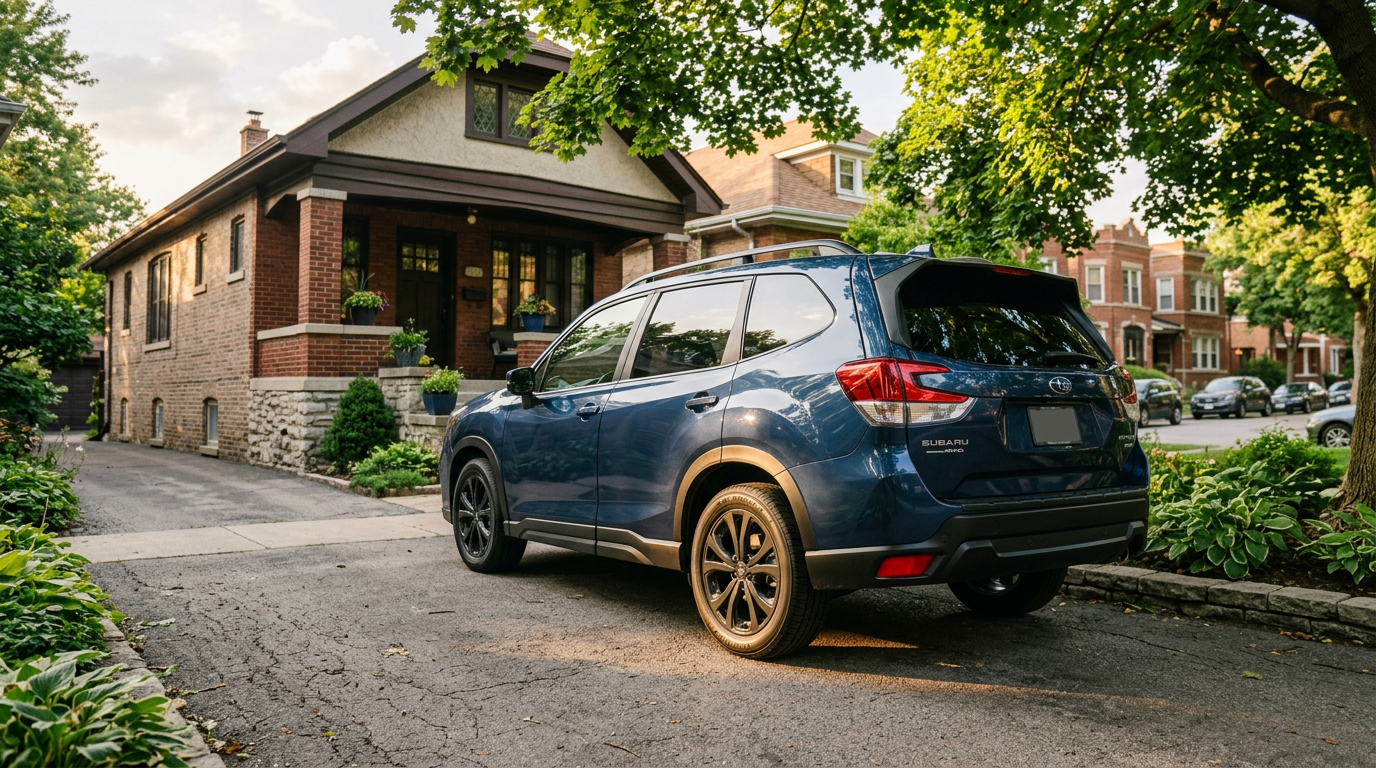
To keep your vehicle performing safely and efficiently, following the manufacturer's recommended maintenance schedule is essential. For most modern vehicles, including the 2026 Subaru Forester and 2026 Subaru Outback, the standard guideline is to rotate your tires every 6,000 miles or 6 months, whichever comes first. This interval is designed to ensure that tread wear is distributed evenly across all four wheels, preserving the balanced handling characteristics of your vehicle.
Sticking to this schedule is particularly important because of how power is distributed to the ground. In stop-and-go city traffic, front tires experience higher forces from steering and braking, which naturally causes them to wear at a different rate than the rear tires. By visiting us for regular maintenance, you ensure that these forces do not lead to localized bald spots or premature tire failure.
If you are noticing uneven wear patterns or if your vehicle has reached its next mileage milestone, you can easily schedule your service online to secure a convenient time. For those driving near our physical location, you can find easy directions to our service center on the northwest side. If you prefer to speak directly with a service advisor to discuss your driving habits, feel free to give our team a quick call at (708) 943-9726.
Table of Contents
- Maintaining Your Symmetrical All-Wheel Drive and the Risks of Uneven Wear
- How Severe Winter Driving and Potholes Impact Tire Lifespan
- The Role of Subaru X-MODE and Symmetrical AWD in Tire Preservation
- Measuring Tread Depth and Knowing When to Order Replacement Tires
- Quick Answers Before You Visit
- Keep Your Subaru Performing Safely with Certified Care
Maintaining Your Symmetrical All-Wheel Drive and the Risks of Uneven Wear
Subaru vehicles are famous for their Symmetrical All-Wheel Drive system, which continuously sends power to all four wheels for maximum traction. However, this sophisticated drivetrain requires all four tires to be virtually identical in circumference. If you do not rotate your tires regularly, the front and rear tires will develop different tread depths. This difference in tire size forces the center differential to work continuously to compensate for the varying rotational speeds, leading to excessive heat buildup and potential drivetrain damage.
To protect your drivetrain from these costly repairs, our factory-certified technicians use a specific tire rotation pattern. For most Symmetrical AWD models, we perform a straight rotation where the front tires move straight back to the rear, and the rear tires cross over to the opposite sides on the front. This specific pattern counteracts the unique lateral wear patterns that develop during daily urban driving.
Skipping these routine rotations can also void parts of your powertrain warranty, as driving with mismatched tire circumferences places undue strain on the transfer clutch and differentials. To help keep your maintenance costs manageable, we regularly update our list of available service specials on our website, making it easy to combine your routine tire rotation with other essential seasonal care.
How Severe Winter Driving and Potholes Impact Tire Lifespan
While the standard 6,000-mile interval is a highly reliable baseline, the reality of navigating winter roads in Chicago often demands closer attention. Freezing temperatures, heavy road salt, and the inevitable onslaught of deep potholes can quickly disrupt your vehicle's wheel alignment. When a wheel is knocked out of alignment by a sharp impact, it forces the tire to drag slightly sideways, rapidly accelerating tread wear on either the inner or outer shoulder.
During the coldest months of the year, tire pressure drops by roughly 1 to 2 pounds for every 10-degree decrease in outdoor temperature. Driving on underinflated tires increases the flexing of the tire sidewall, which generates excess heat and leads to rapid, irregular shoulder wear. It is highly recommended to check your tire pressure at least once a month during the winter to ensure your tires are operating at the correct inflation pressure specified on your driver's side doorjamb.
Our certified technicians look for these subtle alignment and inflation issues during every multi-point inspection. If your tires are wearing unevenly due to alignment issues, a professional four-wheel alignment is necessary to restore your vehicle's precise tracking. If you are also interested in keeping your vehicle's overall performance optimized, you can check our current service offers to see how we support long-term ownership value with our certified maintenance packages.
The Role of Subaru X-MODE and Symmetrical AWD in Tire Preservation
The Symmetrical All-Wheel Drive system works in tandem with active safety systems to maintain grip on slippery surfaces. When you engage X-MODE, the vehicle alters its engine output, transmission shift points, and braking system to maximize traction on steep inclines or deep snow. This system is incredibly effective at preventing wheel spin, which is one of the primary causes of sudden, severe tire wear on icy roads.
By controlling individual wheel braking, the traction control system prevents a single wheel from spinning uselessly on a patch of ice. This precise control means that your tires are subjected to less friction and tearing than they would be on a traditional part-time four-wheel-drive system. However, for these electronic systems to calculate traction accurately, they rely on consistent feedback from all four wheels.
If your tires have significantly different tread depths, the wheel speed sensors may misinterpret the difference in tire diameter as wheel slip. This can cause the traction control or AWD systems to engage unnecessarily, creating a rougher ride and putting extra stress on your tires. Regular rotations ensure that all four tires maintain a uniform diameter, allowing these advanced safety systems to operate exactly as designed.
Measuring Tread Depth and Knowing When to Order Replacement Tires
Monitoring your tire tread depth is a critical part of vehicle safety, especially when preparing for wet or snowy weather. While tires are legally worn out when they reach a tread depth of 2/32 of an inch, driving on tires this thin in wet conditions drastically increases your risk of hydroplaning. For reliable stopping power on wet roads and slush, we strongly recommend replacing your tires once they wear down to 4/32 of an inch.
You can easily check your tread depth at home using a simple penny test. Insert a penny upside down into the tread groove with Lincoln's head facing you. If you can see the top of Lincoln's head, your tread is below 2/32 of an inch and needs immediate replacement. Additionally, modern tires feature built-in treadwear indicators—raised bars running across the tread grooves—that become flush with the tread surface when the tire reaches its legal wear limit.
Because of the strict tolerances of the Symmetrical AWD system, you must replace all four tires at the same time if the tread depth difference between the deepest and shallowest tire exceeds 2/32 of an inch. Replacing only one or two tires will create a diameter mismatch that can damage your drivetrain. When it is time for a new set, you can easily order genuine Subaru parts online through our department to find tires that are factory-matched to your specific model.
Quick Answers Before You Visit
Q: How often should you rotate the tires on a 2024 Subaru?
Subaru recommends rotating your tires every 6,000 miles or 6 months, whichever comes first, to ensure even wear across the Symmetrical All-Wheel Drive system. This interval should be maintained even if the tires look visually uniform, as subtle wear differences can develop before they are easily visible to the naked eye.
Q: Do Subaru vehicles require a four-wheel alignment during a tire rotation?
An alignment is not strictly required during every tire rotation, but it is highly recommended to have your alignment checked at least once a year. If you notice your vehicle pulling to one side or if you frequently travel over rough roads, having our technicians perform a four-wheel alignment will prevent premature tire wear.
Q: Do Subaru dealerships accept drive-in appointments for tire rotations?
Many dealerships offer express service lanes for basic maintenance like oil changes and tire rotations where no appointment is required. However, we highly recommend scheduling your appointment online in advance to minimize your wait time and ensure our team is ready to service your vehicle promptly.
Q: What should I do if my tire blows out while driving?
If you experience a sudden tire blowout, do not slam on the brakes or abruptly release the accelerator. Keep a firm, two-handed grip on the steering wheel, gradually ease off the accelerator, and steer gently to maintain a straight path until the vehicle slows down enough to pull over safely. If you need assistance on the road, you can contact Subaru Roadside Assistance: 800-261-2155 for manufacturer-backed support and towing to our authorized service center.
Keep Your Subaru Performing Safely with Certified Care
Taking proper care of your tires is one of the easiest and most effective ways to protect your vehicle's Symmetrical AWD system and ensure your family's safety on the road. From routine tire rotations and wheel alignments to complete tire replacements, our factory-trained technicians are here to provide the precise, high-quality care your vehicle deserves. We use specialized diagnostic equipment and carry a wide selection of major tire brands engineered specifically for your vehicle's suspension and drivetrain.
Whether you are commuting daily through Irving Park or planning a weekend getaway along the Lake Michigan shoreline in Rogers Park, maintaining even tire wear is the key to a smooth, safe ride. Do not wait for uneven wear or vibrations to impact your driving experience. Schedule your next service appointment online today, or stop by our service center at 4330 W Irving Park Rd, Chicago, IL 60641 to keep your vehicle ready for any road ahead.
© 2026 Berman Subaru of Chicago. All rights reserved.