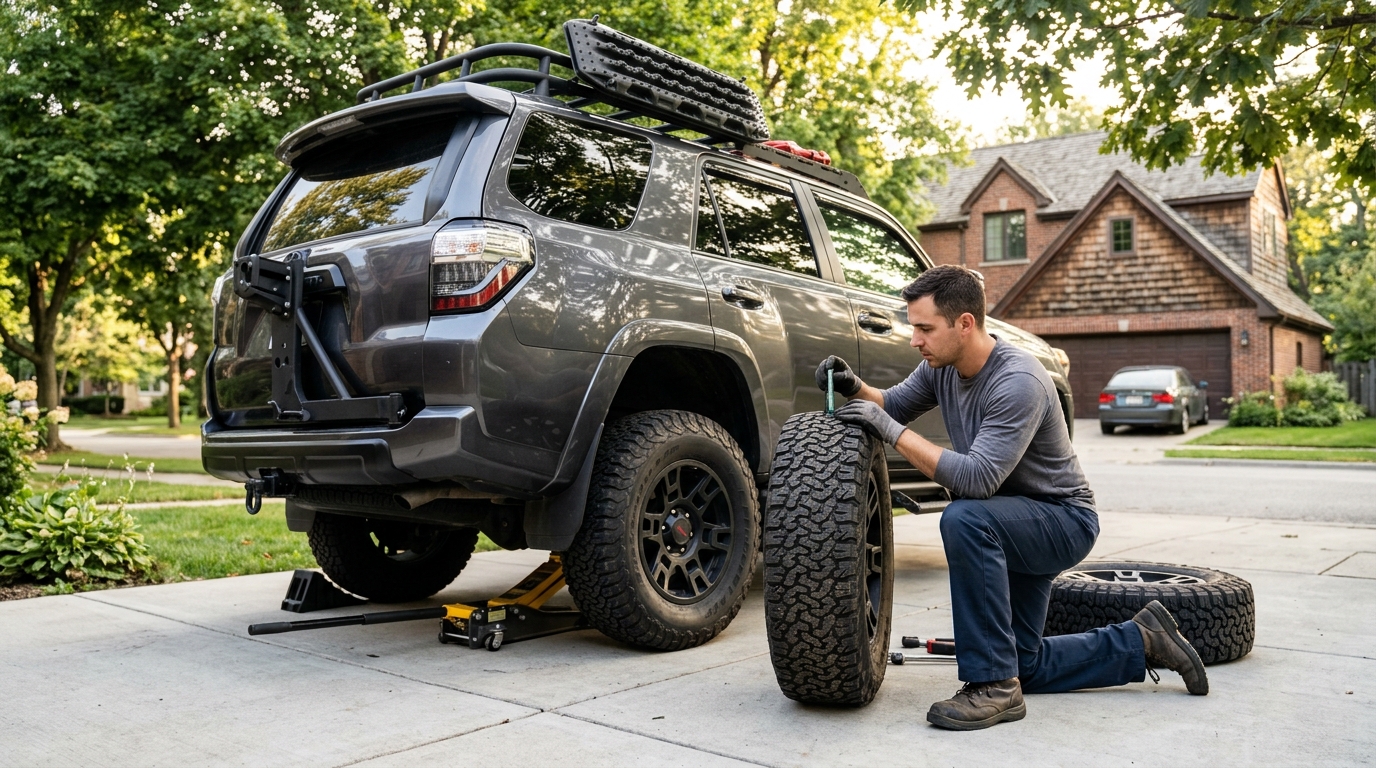
A 5-tire rotation is recommended whenever a vehicle carries a fully matching full-size spare tire with identical wheel dimensions, speed ratings, and tread design, but it is not strictly required if the spare is temporary or directional. Including a matching full-size spare in routine tire maintenance spreads tread wear evenly across five tires rather than four, extending overall tire set lifespan by roughly 20 percent and preventing circumference variations that stress all-wheel-drive systems. However, exceptions apply: directional tread designs, staggered fitments, and temporary compact spares should never be included in a 5-tire rotation pattern.
When a vehicle leaves the factory with four road tires and a matching fifth tire stored under the cargo floor or on a rear mount, that fifth tire is designed to operate on any corner of the vehicle. When left unused in storage, an unrotated spare retains its original 10/32 inch or 11/32 inch factory tread depth while the four active road tires wear down over thousands of miles. If a flat tire occurs after 20,000 miles, mounting that pristine full-size spare alongside three partially worn tires creates an immediate difference in tire diameter. On vehicles with advanced drivelines, that diameter gap causes the wheel on the spare tire corner to rotate at a different speed than the other three wheels, generating mechanical friction in the transfer case and center differential.
Integrating the spare into regular rotation cycles eliminates this mechanical risk. Performing a 5-tire rotation at every scheduled maintenance interval—typically every 6,000 miles or 6 months—ensures that all five tires wear down at an identical rate. This practice provides uniform traction in wet or snowy driving conditions and ensures that if a tire suffers puncture damage beyond repair, you still have a fully matched tire ready to perform without requiring an emergency purchase of four new tires.
For driver-assist systems and vehicle stability controls to operate safely, consistent tire rolling radius is essential. You can consult our factory-trained technicians at our Irving Park service facility or give our team a quick call to verify whether your current tire set and spare qualify for a 5-tire rotation schedule.
Table of Contents
- Why Do Most Modern Vehicles Come With a Temporary Donut Spare Instead of a Full-Size Spare?
- What Are the Main Benefits of Including a Full-Size Spare in Your Tire Rotation Cycle?
- Can Mismatched Tread Depth From an Unrotated Spare Damage an AWD Drivetrain?
- What Tire Pressure and Maintenance Rules Apply to Full-Size Spare Tires?
- What Are the Proper 5-Tire Rotation Patterns for AWD, FWD, and RWD Vehicles?
- Frequently Asked Questions About Full-Size Spare Tire Rotations
- Schedule Certified Tire Maintenance at Berman Subaru
Why Do Most Modern Vehicles Come With a Temporary Donut Spare Instead of a Full-Size Spare?
Automakers equip most modern vehicles with compact temporary spares primarily to reduce overall vehicle curb weight, maximize trunk cargo volume, improve fuel economy ratings, and lower manufacturing costs. A temporary donut spare weighs significantly less than a standard wheel and tire assembly, which helps engineering teams meet stringent federal fuel efficiency standards while freeing up valuable cabin and under-floor storage space.
A full-size wheel and tire combination requires a deep, wide storage well in the trunk or underbody structure. On popular crossover platforms like the 2026 Subaru Forester, keeping the rear floor flat allows for up to about 30 cubic feet of rear cargo space, ideal for groceries, athletic gear, and luggage. Replacing a full-size spare with a lightweight compact spare saves up to 30 pounds of dead weight. This weight reduction directly assists the 2.5L engine and Lineartronic CVT in achieving an EPA-estimated 26 city / 33 hwy fuel efficiency rating.
While compact donut spares successfully save space and weight, they carry strict operational limits:
- Speed restrictions capped strictly at 50 mph
- Distance limits generally restricted to 50 miles or less
- Shallower tread depth and lighter construction meant strictly for emergency transit to a repair shop
- Reduced traction and altered handling characteristics during cornering and heavy braking
- Incompatibility with regular tire rotation cycles due to smaller rolling diameter and lower load capacity
For drivers who require full off-road capability or frequently travel through remote areas, select rugged trim levels—such as the 2026 Subaru Outback Wilderness with its standard 2.5L powertrain and elevated ground clearance—include a matching full-size spare directly from the factory. If your vehicle came with a temporary spare and you wish to explore upgrade options or seasonal maintenance offers, browse our current service and maintenance specials or order genuine Subaru replacement wheels and tires directly through our team.
What Are the Main Benefits of Including a Full-Size Spare in Your Tire Rotation Cycle?
Rotating a matching full-size spare across all wheel positions delivers major financial and mechanical benefits by maximizing tread longevity, maintaining balanced traction, and protecting expensive driveline components. Spreading wear across five tires instead of four increases total tire set mileage by up to 20 percent before a complete replacement set is required.
Front tires shoulder the majority of steering, cornering, and forward braking forces, causing their tread blocks to wear faster and differently than the rear tires. In a standard 4-tire rotation, front and rear tires trade places to equalize this wear. In a 5-tire rotation pattern, every tire takes a turn resting in the spare storage compartment for one service cycle. This rotating rest period gives each tire a break from heat generation and road friction, promoting uniform tread depth degradation across all five tires.
Key advantages of maintaining a 5-tire rotation schedule include:
- Extended overall tread life by dividing total vehicle mileage across five tires
- Perfectly balanced traction and cornering stability across all four active wheel positions
- Prevention of drivetrain binding caused by tread depth variance on all-wheel-drive vehicles
- Immediate availability of a fully usable, road-ready spare in the event of a blowout
- Maximized return on investment for high-grade all-terrain or winter tire sets
When all five tires share identical wear patterns, replacing a damaged tire becomes stress-free. Instead of buying an entire new set of four tires because one active tire suffered sidewall damage, you simply place the matching spare into full-time service and acquire a new spare. This preserves equal rolling circumference across the entire vehicle without sacrificing safety or handling precision.
Can Mismatched Tread Depth From an Unrotated Spare Damage an AWD Drivetrain?
Installing an unrotated brand-new full-size spare alongside three worn tires on an all-wheel-drive vehicle creates a rolling circumference mismatch that can overheat and permanently damage the transfer case, viscous coupling, or center differential. Because all-wheel-drive systems continuously monitor and balance power distribution between the front and rear axles, mismatched tire diameters force drivetrain components to work continuously to compensate for rotational speed differences.
Subaru vehicles feature continuous Symmetrical All-Wheel Drive, which relies on precise mechanical tolerances to distribute torque smoothly. Subaru technical guidelines specify that all four tires on an active vehicle must have matching rolling circumferences, with a maximum allowable tread-depth difference of 2/32 inch (roughly 0.25 inch in total circumference) between any two tires. If three road tires have worn down to 5/32 inch of tread depth and you install an unrotated full-size spare with its original 10/32 inch factory tread, the 5/32 inch difference far exceeds factory tolerance limits.
The mechanical consequences of running mismatched tire sizes on an all-wheel-drive system include:
- Continuous differential friction and fluid overheating due to speed discrepancies between axles
- Premature wear or total failure of internal clutch packs, transfer gears, and center bearings
- False activation of anti-lock braking (ABS) and traction control sensors
- Increased road noise, chassis vibration, and reduced fuel efficiency
- Potential voiding of vehicle drivetrain warranty coverage due to improper tire sizing
When vehicle owners ask our service technicians about replacing a single damaged tire on an AWD model, we walk them through why a brand-new tire paired with three partially worn ones can cause driveline binding during tight turning maneuvers. Severe winter driving across Chicago demands uncompromised power transfer to all four wheels; keeping all five tires closely matched in tread depth preserves the integrity of your drive system through deep snow and icy pavement.
What Tire Pressure and Maintenance Rules Apply to Full-Size Spare Tires?
A full-size spare tire must be maintained at the exact cold inflation pressure recommended on the driver-side door jamb placard, requiring routine pressure checks and physical inspections at every scheduled maintenance service. Because spare tires sit enclosed in cargo wells or mounted externally, air pressure drops naturally over time due to ambient temperature swings and subtle valve stem permeability.
Checking tire pressure when tires are "cold"—meaning the vehicle has been parked for at least three hours—is essential for accurate pressure readings. Ambient winter temperatures cause tire pressure to drop by roughly 1 psi for every 10-degree Fahrenheit drop in outside air temperature. A spare tire stored under the trunk floor that was inflated to 32 psi during summer maintenance can easily drop below 25 psi during a mid-winter cold snap, leaving it underinflated when an emergency roadside flat occurs.
Essential maintenance practices for full-size spare tires include:
- Verifying inflation pressure with a digital gauge during every oil change and tire service
- Inspecting the spare sidewall for rubber degradation, cracking, or age-related dry rot
- Checking wheel lug nut torque and ensuring the spare mounting hardware remains clean and rust-free
- Matching cold tire pressure strictly to the door jamb placard rather than the maximum pressure stamped on the tire sidewall
- Replacing full-size spare tires that reach 6 to 10 years of age regardless of remaining tread depth
Regular inspection prevents uncomfortable surprises when a flat tire leaves you stranded on the shoulder of a busy highway. You can easily schedule a comprehensive tire inspection and rotation online with our certified service team to ensure your active tires and full-size spare remain fully air-tight, properly balanced, and mechanically sound.
What Are the Proper 5-Tire Rotation Patterns for AWD, FWD, and RWD Vehicles?
Proper 5-tire rotation patterns move tires systematically between active axle positions and the spare storage compartment based on drivetrain configuration and tread orientation, ensuring that every tire changes direction of wear over time. Drivetrain layout determines which axle experiences the highest acceleration, steering, and braking forces.
+-----------------------------------------------------------------------------------+
|                            5-TIRE ROTATION PATTERNS                               |
+-------------------+---------------------------------------------------------------+
| DRIVETRAIN TYPE   | ROTATION DIRECTION & MOVEMENT STEPS                           |
+-------------------+---------------------------------------------------------------+
| All-Wheel Drive   | Rearward Cross: Spare -> Right Front -> Left Rear ->          |
| (AWD) & 4WD       | Left Front -> Right Rear -> Spare                             |
+-------------------+---------------------------------------------------------------+
| Front-Wheel Drive | Forward Cross: Spare -> Right Rear -> Right Front ->          |
| (FWD)             | Left Rear -> Left Front -> Spare                              |
+-------------------+---------------------------------------------------------------+
| Rear-Wheel Drive  | Rearward Cross: Spare -> Right Front -> Left Rear ->          |
| (RWD)             | Left Front -> Right Rear -> Spare                             |
+-------------------+---------------------------------------------------------------+
For all-wheel-drive and four-wheel-drive vehicles equipped with non-directional symmetrical tires, the standard procedure is the rearward cross pattern. In this sequence:
- The spare tire moves into the right front position.
- The right front tire crosses to the left rear position.
- The left rear tire moves straight forward to the left front position.
- The left front tire crosses to the right rear position.
- The right rear tire moves into the spare compartment as the new rest tire.
Front-wheel-drive vehicles utilize a forward cross pattern to account for the heavy wear placed on the front axle by steering and propulsion. The spare tire moves to the right rear, the right rear tire crosses to the right front, the right front tire moves to the left rear, the left rear tire moves to the left front, and the left front tire enters storage as the spare.
Directional tires—which feature tread V-grooves designed to channel water in a single rolling direction—present a unique limitation. Because a directional tire cannot switch from the passenger side to the driver side without being unmounted and remounted backwards on its rim, 5-tire rotations on directional sets are rarely performed unless the spare is dedicated strictly to one side of the vehicle or remounted during every service.
Frequently Asked Questions About Full-Size Spare Tire Rotations
Q: Do all vehicle manufacturers recommend rotating a full-size spare tire?
No, not all manufacturers recommend 5-tire rotations. While many truck and SUV maker owner manuals detail 5-tire rotation patterns, some manufacturers explicitly instruct owners to keep full-size spares strictly as emergency backups. Vehicle owner manuals specify whether a 5-tire pattern is supported based on rim design, tire pressure sensor programming, and wheel offset.
Q: What tools are required to perform a 5-tire rotation at home?
Performing a 5-tire rotation requires a hydraulic floor jack, at least two heavy-duty jack stands, wheel chocks, a lug wrench or breaker bar, a calibrated torque wrench, and a cold tire pressure gauge. Jack stands are critical because the vehicle must be elevated safely while multiple wheels are removed simultaneously.
Q: Will a 5-tire rotation interfere with the Tire Pressure Monitoring System (TPMS)?
Modern TPMS sensors monitor air pressure inside each wheel and transmit wireless signals to the vehicle computer. When a 5-tire rotation is performed, the sensor inside the spare tire enters active service while the removed tire's sensor goes into storage. Most vehicles require a quick TPMS relearn procedure using a service tool so the dashboard display accurately identifies each tire position.
Q: Can I perform a 5-tire rotation if my spare wheel does not match the road wheels?
You should not include a spare tire in a rotation pattern if its wheel differs in diameter, width, or offset from the four active road wheels. Even if the tire rubber matches in size code, mounting a steel spare wheel alongside three alloy wheels alters suspension unsprung weight, wheel balance, and hub seating tolerances, which impairs high-speed handling stability.
Q: How often should a 5-tire rotation be performed on an all-wheel-drive crossover?
A 5-tire rotation on an all-wheel-drive crossover should occur every 6,000 miles or 6 months, matching standard oil change and chassis maintenance intervals. Sticking strictly to this timeframe prevents tread depth variations from exceeding the 2/32 inch tolerance limit required to protect center differentials and transfer cases.
Schedule Certified Tire Maintenance at Berman Subaru
Keeping your tires properly rotated, balanced, and inflated protects your vehicle's mechanical drive system while ensuring optimal road grip in difficult weather. Whether your vehicle is equipped with a matching full-size spare or a standard tire set, our factory-trained service technicians deliver accurate maintenance tailored to your specific model's specifications.
Our factory-certified technicians inspect tread wear depth, verify TPMS sensor calibration, check cold inflation pressures, and execute precise rotation patterns to maximize tire lifespan. Visit our service department in Chicago for your next tire service, or call our advisors directly at (708) 943-9726 to reserve your maintenance appointment today.