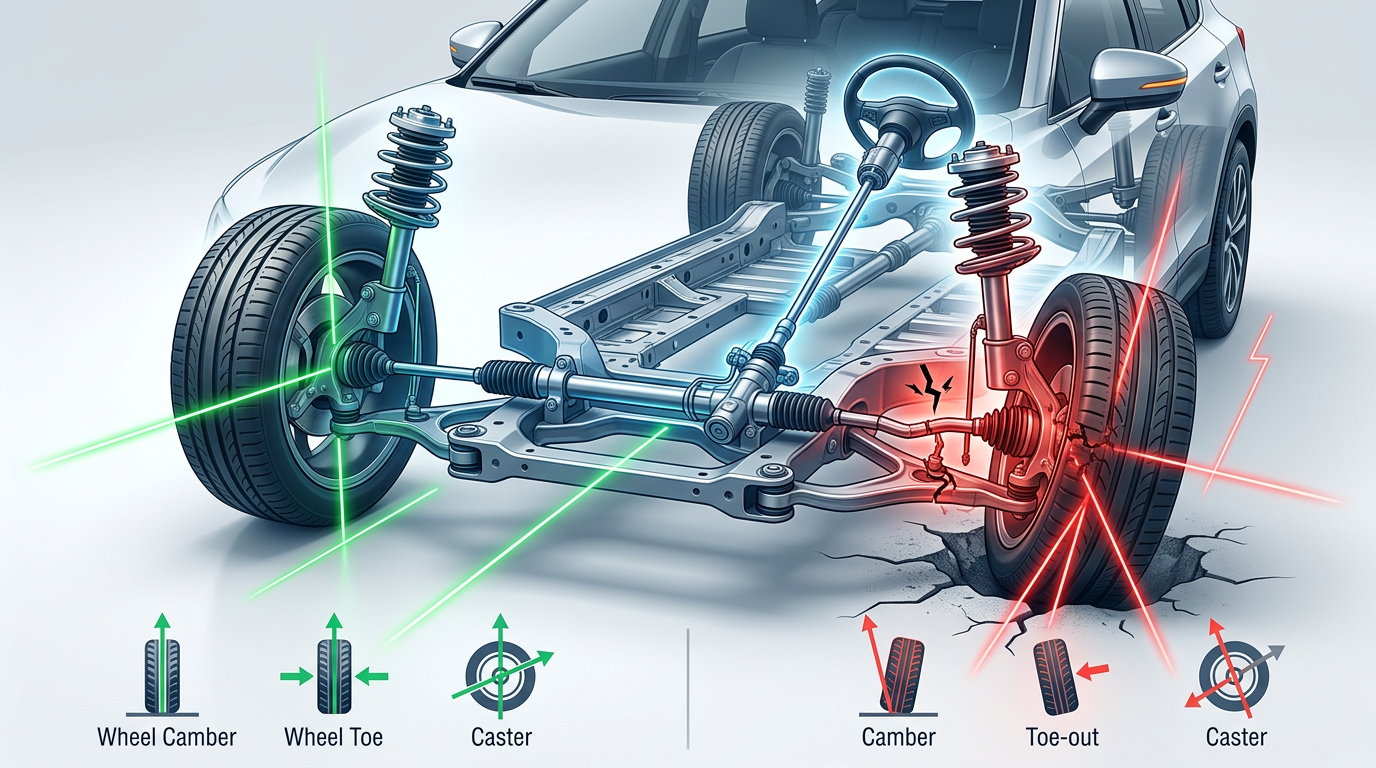
The transition from a freezing winter to warmer spring weather brings a familiar and challenging driving hazard to the local streets. As sub-freezing temperatures fluctuate, moisture seeps into the asphalt, freezes, expands, and collapses under the weight of daily traffic. This process leaves behind deep, sharp-edged craters that can severely impact your vehicle's steering and suspension systems. Navigating these sudden road hazards is a daily reality for commuters traveling along major commercial corridors like Irving Park Road.
Even if you manage to avoid a major tire blowout, hitting a deep asphalt crater can quietly alter the precise steering geometry of your vehicle. Over time, driving with compromised steering angles accelerates tire wear and compromises the handling characteristics designed to keep you safe. Subaru vehicles are engineered with active lifestyles in mind, utilizing advanced safety systems that rely on precise mechanical calibration to function optimally.
Addressing steering and suspension issues early prevents minor alignment variations from developing into costly mechanical repairs. If you recently experienced a harsh impact on your daily commute, we recommend having your vehicle evaluated by factory-trained technicians who understand the specific engineering of your vehicle. For immediate assistance or to discuss your vehicle's handling behavior, you can reach our service team by giving us (708) 943-9726 a quick call. If you prefer to have our team inspect your vehicle in person, you can easily find our service center location to plan your visit.
Table of Contents
- How Potholes Impact and Damage Your Suspension and Alignment
- Signs of a Misaligned Wheel and How to Check for Damage After a Hard Hit
- Decoupling Alignment and Balance: Wheel Balancing vs Alignment and Steering Vibrations
- The True Cost of Poor Alignment: Lower Gas Mileage and Accelerated Tire Wear
- Understanding Service Details: Two-Wheel vs Four-Wheel Alignments and Warranty Coverage
- Common Questions About Post-Pothole Steering and Alignment Care
How Potholes Impact and Damage Your Suspension and Alignment
When a vehicle strikes a deep, sharp-edged road depression, the tire and wheel assembly are subjected to a sudden, violent upward and rearward force. Under normal driving conditions, the suspension system compresses and rebounds gradually to absorb road imperfections. However, the impact of a severe asphalt crater can exceed the travel capacity of the shocks and struts, transferring the energy directly into the solid mechanical linkages of your steering and suspension systems.
This intense force can easily bend or distort critical components that dictate your steering angles. The parts most susceptible to this type of impact damage include:
- Control arms and rubber bushings that manage lateral wheel movement
- Tie rod ends that connect the steering gear to the wheel knuckles
- Suspension struts and coil springs that support vehicle weight and absorb road shock
- Ball joints that act as the pivot points between the wheels and the suspension
When any of these components are bent or knocked out of their factory specifications, the alignment angles of your wheels are altered. For instance, a slightly bent tie rod will directly change the toe angle, causing the front tires to point inward or outward rather than tracking perfectly straight. Ignoring these bent components puts additional stress on connected steering parts, which can lead to premature mechanical failure. If our technicians discover damaged suspension components during an inspection, we utilize only factory-authorized replacement parts to restore your vehicle to its original operating standards. You can order genuine Subaru parts directly through our department to ensure your vehicle's structural integrity is maintained with components designed specifically for your model.
Signs of a Misaligned Wheel and How to Check for Damage After a Hard Hit
How quickly do symptoms of a misaligned wheel appear after a hard road impact? While a severe impact can instantly bend a steering component and cause an immediate change in handling, more subtle structural shifts might take several hundred miles to become noticeable. Drivers often first recognize a problem when they observe uneven wear patterns developing across the tread face of their tires.
To identify potential steering and suspension issues before they lead to severe tire damage, watch for these common physical symptoms:
- The vehicle actively pulls or drifts to one side when you try to drive straight on a flat road
- The steering wheel remains tilted or off-center when the vehicle is traveling in a straight line
- The steering feels unusually loose, unresponsive, or exhibits a wandering sensation at highway speeds
- The tires begin to squeal or chirp when taking normal turns at low speeds
If you experience a particularly harsh jolt while driving, it is highly recommended to perform a safe visual inspection of your vehicle once you are parked on flat ground. Start by inspecting the tire sidewalls for any protruding bulges, cuts, or deep scuffs, which indicate that the internal tire cords have ruptured from being pinched against the wheel rim. Next, examine the metal edge of your wheels for flat spots, dents, or cracks that could cause air loss. Finally, look beneath the vehicle for any signs of fresh fluid leaks, which could indicate a damaged shock absorber or a torn steering rack boot. Keeping your vehicle in peak mechanical condition ensures you can safely enjoy seasonal road trips and take advantage of our new vehicle inventory when it is eventually time to transition to a newer model.
Decoupling Alignment and Balance: Wheel Balancing vs Alignment and Steering Vibrations
A common point of confusion for many drivers is the difference between wheel balancing and a wheel alignment. While both services are essential for maintaining a smooth ride and extending the life of your tires, they address entirely different mechanical issues. It is highly common to have wheels that are perfectly balanced to spin without shaking, yet still sit at incorrect steering angles that cause the vehicle to drift and wear down the tread prematurely.
Wheel balancing is the process of compensating for uneven weight distribution within the tire and wheel assembly. Because no tire or wheel is perfectly uniform in weight, small heavy spots exist. Technicians resolve this by mounting the wheel on a specialized balancing machine that spins the assembly to identify heavy spots, then placing small adhesive or clip-on lead weights on the rim to ensure the wheel spins evenly.
In contrast, a wheel alignment does not adjust the tires or wheels themselves. Instead, an alignment adjusts the physical steering and suspension angles so that the wheels track parallel to each other and perpendicular to the road surface. If you feel a distinct vibration through your steering wheel or vehicle seat that intensifies as your speed increases, the issue is almost always an unbalanced wheel or a bent rim. However, if your steering wheel is smooth but the vehicle constantly fights to pull you toward the shoulder of the road, the suspension angles are misaligned.
The True Cost of Poor Alignment: Lower Gas Mileage and Accelerated Tire Wear
Driving a vehicle with compromised steering geometry has direct financial consequences that extend far beyond a slightly crooked steering wheel. When your wheels are out of alignment, they no longer roll in perfect harmony with the direction of travel. Instead, one or more tires drag slightly sideways against the pavement as you drive, creating a continuous scrubbing action.
This dragging effect significantly increases the rolling resistance of your vehicle. Because the tires are fighting against each other rather than rolling smoothly, the engine must work harder and consume more fuel to maintain a constant highway speed. Over several months of daily commuting, this drop in efficiency can noticeably increase your monthly fuel expenses.
Furthermore, the friction caused by this scrubbing action rapidly accelerates tire wear, often wearing down the inner or outer edges of the tread in a matter of weeks. Replacing a set of premium all-weather tires prematurely is a significant and avoidable expense. By maintaining proper steering specifications, you ensure even tread wear across all four tires, preserve the handling capabilities of your all-wheel-drive system, and maximize your fuel economy. To protect your tire investment and restore your vehicle's efficiency, you can schedule your service online to have our team perform a precision computer alignment.
Understanding Service Details: Two-Wheel vs Four-Wheel Alignments and Warranty Coverage
When scheduling maintenance, it is helpful to understand the specific type of alignment service your vehicle requires. A two-wheel alignment, often referred to as a front-end alignment, only measures and adjusts the steering angles on the front axle. While this may be appropriate for certain front-wheel-drive vehicles with solid rear axles, it is not suitable for modern, highly capable all-wheel-drive vehicles.
A four-wheel alignment is a comprehensive service where technicians measure and adjust the steering geometry on both the front and rear axles. This ensures that the rear wheels track perfectly in line with the front wheels, which is critical for maintaining the handling dynamics of vehicles like the 2026 Subaru Forester or the 2026 Subaru Outback. During this service, our technicians utilize specialized computerized equipment to measure three primary angles:
- Camber: The inward or outward tilt of the tire when viewed from the front of the vehicle
- Caster: The forward or backward tilt of the steering axis when viewed from the side
- Toe: The direction the tires point relative to the centerline of the vehicle when viewed from directly above
Drivers often ask if a wheel alignment is covered under their new vehicle warranty. Because alignments are directly influenced by external road conditions, potholes, and curb impacts, they are classified as wear-and-tear maintenance items and are generally not covered under standard manufacturer warranties. The only exception is if the alignment deviation is the direct result of a factory defect in a covered suspension component. To help keep your seasonal maintenance affordable, we invite you to review our current service information for ways to learn more on your next alignment or multi-point inspection.
Common Questions About Post-Pothole Steering and Alignment Care
Q: Can a bad wheel alignment damage other parts of my car?
Yes, ignoring a misaligned suspension puts continuous, uneven stress on other connected mechanical parts. Over time, the increased friction and improper angles can cause premature wear on your shock absorbers, ball joints, wheel bearings, and steering gear, leading to much more expensive repairs down the road.
Q: How long does a standard four-wheel alignment service take?
A professional four-wheel alignment typically takes between 45 minutes and an hour to complete using specialized computerized equipment. However, if our technicians discover bent or damaged suspension components that must be replaced before the alignment can be performed, the process will take longer to ensure your vehicle is safe to drive.
Q: Will my vehicle's safety features be affected by a bad alignment?
Yes, modern safety technologies rely on precise vehicle tracking and sensor calibration to function correctly. If your vehicle is misaligned and pulling to one side, it may affect the performance of certain driver-assist systems, making a proper alignment important for safe operation.
Q: How often should I have my alignment checked if I don't feel any symptoms?
We recommend having your alignment checked at least once a year or every 12,000 miles, as well as immediately after hitting a major pothole. Regular inspections help catch minor alignment variations early, protecting your tires from uneven wear before the physical symptoms become obvious.
Our team at Berman Subaru of Chicago is dedicated to keeping your vehicle performing safely and reliably through every season. If you suspect your steering or suspension has been compromised by recent road hazards, please reach out to our service advisors by calling (708) 943-9726 to discuss your concerns. For in-person support, diagnostics, and precision alignment services, you can get directions to our Chicago service center and let our factory-trained technicians restore your vehicle's smooth ride.
© 2026 Berman Subaru of Chicago. All rights reserved.