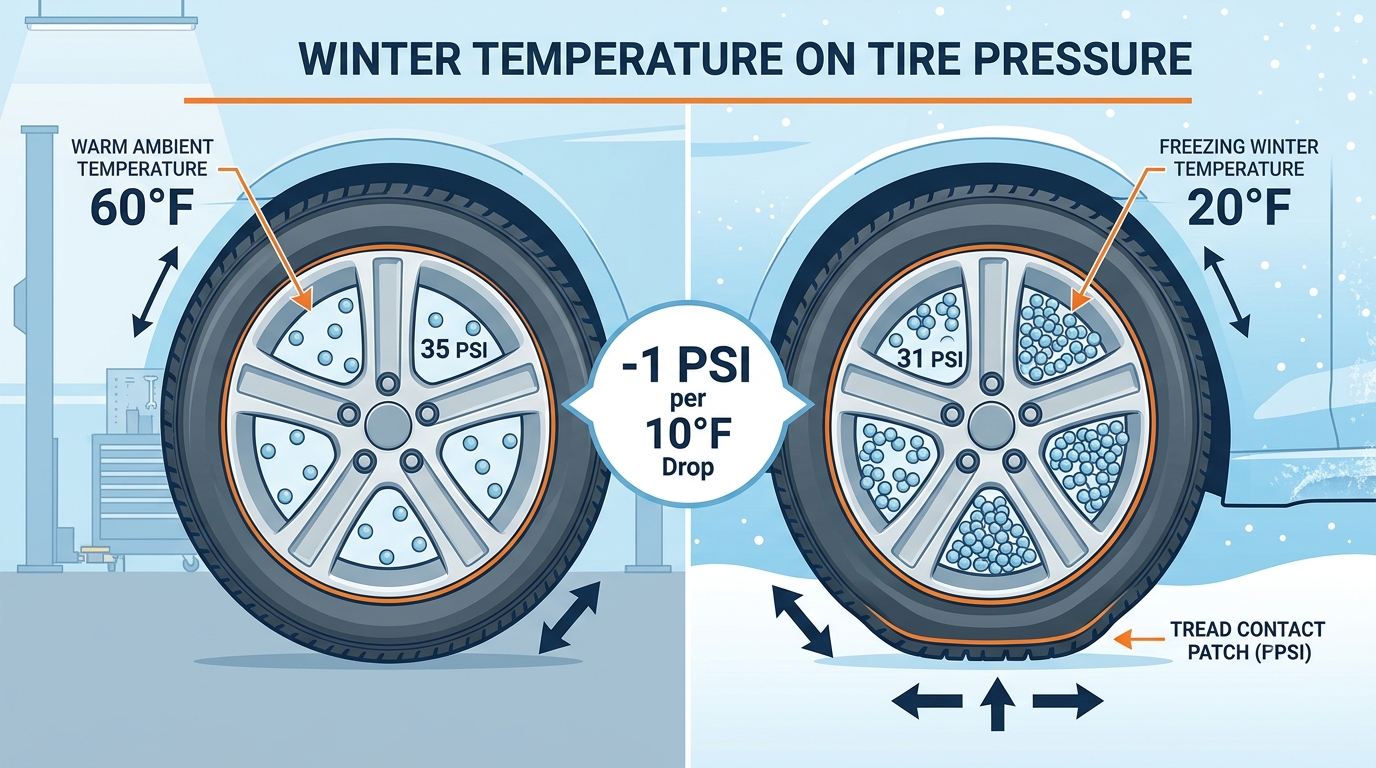
Cold winter temperatures reduce tire pressure by approximately 1 PSI for every 10°F drop in ambient temperature. As outside air cools, compressed air molecules inside the tire contract and occupy less volume, lowering internal pressure. Sudden overnight freezes can easily cause a tire to drop 3 to 5 PSI, decreasing traction and triggering tire pressure monitoring system warnings.
This thermal contraction happens naturally in all pneumatic tires regardless of vehicle age or condition. When warm autumnal weather gives way to prolonged freezing conditions, a tire properly set at 35 PSI during a 60°F afternoon can drop to 31 PSI when morning temperatures plunge to 20°F. The physical mass of air within the wheel cavity remains unchanged, but the reduced molecular motion exerts significantly less force against the inner tread and sidewall structure.
Sustained exposure to extreme cold accelerates this pressure reduction. Navigating stop-and-go morning traffic along Irving Park Road in sub-zero temperatures makes properly pressurized tires essential for crisp throttle response and predictable braking. If you suspect an abnormal pressure loss beyond standard thermal fluctuation, our factory-trained technicians at our service center location on West Irving Park Road can perform a complete valve stem and bead inspection, or you can reach our team directly at (708) 943-9726 for immediate maintenance advice.
Table of Contents
- How Often Should Tire Pressure Be Checked During Chicago Winters?
- Where Can You Find the Vehicle's Recommended Cold Tire Pressure Specification?
- What Are the Safety Risks of Underinflated Tires in Winter Driving?
- How to Properly Check Cold Weather Tire Pressure and Protect Your Fuel Economy?
- Common Questions About Winter Tire Maintenance
- Protect Your Subaru Driving Safety with Seasonal Tire Care
How Often Should Tire Pressure Be Checked During Chicago Winters?
During cold months, drivers should check tire pressure manually at least once every two weeks and immediately following any sudden temperature drop of 10°F or more. Proactive bi-weekly checks ensure tires remain at their optimal cold inflation rating before subtle pressure losses compromise vehicle stability or cause irregular tread wear.
Commuters who drop by our service drive during cold weather swings usually ask whether weekly checks are overkill, and our technicians remind them that a 20-degree drop overnight can easily take 2 PSI off every tire before they even pull out of the driveway. Monthly checks, while sufficient during mild summer months, leave too much room for undetected underinflation during harsh weather transitions. Bi-weekly verification catches natural pressure drops and slow valve stem leaks before severe winter driving conditions test your vehicle's traction boundaries.
Establishing a consistent maintenance routine prevents winter road hazards. Checking pressure on cold morning conditions—before driving more than one mile—provides the most accurate baseline reading. Drivers commuting along the Lake Michigan shoreline near Rogers Park know how harsh winter lake-front winds accelerate ambient temperature drops, making regular tire inspections essential for everyday winter readiness.
Maintaining proper tire pressure is especially vital for vehicles equipped with Symmetrical All-Wheel Drive, such as the Outback or Forester. Equal tire circumference across all four wheels preserves the exact rotational speeds required by the transfer case and center differential. Running even one tire several PSI lower than the others alters its rolling radius, forcing AWD components to work harder to compensate for perceived wheel slip. By routinely verifying tire pressure, you protect complex drivetrain components against unnecessary mechanical stress.
When topping off your tires at home or at a service station, always use a high-quality digital or dial gauge rather than basic pencil-style tools, which can lose calibration when dropped. For driver convenience, our parts department provides factory-approved tire accessories, making ordering genuine Subaru tire pressure gauges or valve caps simple and direct.
Where Can You Find the Vehicle's Recommended Cold Tire Pressure Specification?
The exact cold tire pressure specification for your vehicle is printed on the tire information placard located on the driver-side door jamb. This factory-issued label lists the precise cold inflation values designed for your model's weight distribution, suspension tuning, and original equipment wheel size.
Drivers must always rely on this driver-side door placard or the vehicle owner's manual rather than the maximum pressure rating stamped on the tire sidewall. The number on the sidewall indicates the absolute maximum pressure the tire casing can safely hold at maximum load capacity, not the engineered pressure required for proper handling, fuel efficiency, and braking performance. Inflating a tire to its sidewall maximum leads to a harsh ride, reduced center-tread contact, and heightened susceptibility to impact damage from winter potholes.
The driver-side door placard often includes two distinct pressure targets:
- Standard cold inflation pressure for normal everyday passenger driving
- Loaded inflation pressure recommendations when carrying maximum cargo or towing
Vehicles like the three-row Ascent with its 2.4L turbocharged engine may specify slightly different PSI values between front and rear axles to balance weight distribution when carrying up to seven passengers. Front-axle recommendations account for engine mass and steering loads, while rear specifications handle passenger and cargo weight. Reviewing current vehicle service and maintenance offers can help ensure your tires and multi-point safety inspections stay up to date before major seasonal travel.
What Are the Safety Risks of Underinflated Tires in Winter Driving?
Driving on underinflated tires during winter significantly increases stopping distances, reduces cornering grip, and compromises vehicle control on slippery snow and ice. When internal pressure drops below specification, the center of the tire tread bows inward, lifting away from the road surface and concentrating vehicle weight onto the outer shoulders.
This distorted contact patch severely reduces the tire's ability to bite into packed snow or clear slush from tread channels. Tests reveal that a tire underinflated by just 5 PSI can lengthen winter braking distances by several critical feet on wet or icy pavement. Because the outer shoulders absorb excessive weight, internal tread flexing rises dramatically, generating localized heat that weakens rubber compounds and internal belt structures.
The primary safety hazards caused by low winter tire pressure include:
- Reduced steering crispness and delayed evasive maneuver handling
- Increased susceptibility to hydroplaning or slush-planing at highway speeds
- Elevated risk of sidewall rim pinch damage when striking hidden road hazards
- Accelerated shoulder tread wear that shortens total tire lifespan
- Mechanical strain on full-time all-wheel drive systems due to unequal rolling radii
Underinflated tires also fail to protect expensive alloy wheels from severe winter impacts. Deep asphalt potholes created by freeze-thaw cycles present a constant threat on city streets. A fully pressurized tire acts as a dense pneumatic cushion, absorbing impact force before it reaches the wheel rim or suspension control arms. Operating on low tire pressure allows pothole impacts to crush the tire sidewall directly against the wheel flange, causing bent rims, torn inner liners, or sudden pressure loss.
How to Properly Check Cold Weather Tire Pressure and Protect Your Fuel Economy?
To properly check cold weather tire pressure, measure each tire after the vehicle has been parked for at least three hours or driven less than one mile. Unscrew the valve cap, press your pressure gauge firmly onto the valve stem until the hissing stops, read the PSI value, and compare it against your door jamb specification.
Adjust inflation using a reliable portable compressor or service station air dispenser, adding air in short bursts and rechecking with your gauge until matching the recommended cold PSI. Never release air from a warm tire immediately after extended highway driving; internal pressure naturally rises 3 to 5 PSI as tires warm up, and deflating a warm tire will leave it dangerously underinflated once it cools down.
Checking tire pressure correctly involves a simple, step-by-step process:
- Park the vehicle on level ground in a shaded area or garage and ensure tires are cold.
- Locate the cold PSI target on the driver-side door jamb placard.
- Remove the dust cap from the tire valve stem and store it securely.
- Press the pressure gauge straight onto the valve stem to obtain a clean reading.
- Add or release air in small increments until the target PSI is reached.
- Reinspect the valve stem and firmly reinstall the valve cap to block dirt and road salt.
Maintaining correct winter inflation directly protects your wallet at the fuel pump. Underinflated tires increase rolling resistance, forcing the engine to consume more fuel to maintain cruising speed. Studies from the U.S. Department of Energy show that gas mileage drops by roughly 0.2% for every 1 PSI drop across all four tires. In freezing conditions where engine warm-up cycles already pull down fuel economy, running 5 PSI under specification can noticeably boost winter fuel consumption while accelerating tread degradation.
Common Questions About Winter Tire Maintenance
Q: How often should I check tire pressure in winter if my vehicle has a TPMS?
You should still check tire pressure manually at least once a month in winter even if your car features a Tire Pressure Monitoring System. TPMS is designed as a severe safety threshold alert—typically triggering only when a tire falls 20% to 25% below recommended pressure—rather than a routine maintenance tool. Manual gauge checks catch subtle pressure losses before they cause uneven tread wear or reduced fuel economy.
Q: Is checking tire pressure weekly in winter better than monthly?
Checking tire pressure weekly during severe winter conditions provides superior protection against sudden temperature swings and undetected slow leaks. While bi-weekly checks serve as a practical baseline, weekly verification ensures your tires consistently operate at peak safety specifications during intense cold snaps, preserving traction on icy roads and saving money on fuel.
Q: Should winter tire pressure be set higher than the door jamb placard rating?
No, tire pressure should always be set to the vehicle manufacturer's recommended cold PSI listed on the driver-side door placard regardless of the season. Adding extra air in anticipation of cold weather often leads to overinflation during longer drives, which reduces tire contact with the road, causes center tread wear, and stiffens the ride on rough winter pavement.
Q: Why does my TPMS light turn off after driving for several miles in winter?
Your TPMS warning light turns off after driving because friction between the tire tread and the road generates heat, causing the air inside the tire to expand and temporarily raise internal pressure above the warning threshold. However, once the tire cools back down, the pressure will drop below specification again, meaning you must add air while the tire is completely cold to permanently resolve the low pressure condition.
Q: Does nitrogen inflation eliminate the need for winter tire pressure checks?
Nitrogen inflation reduces the rate of natural pressure loss because nitrogen molecules are larger than oxygen molecules, but it does not eliminate the impact of temperature changes. Nitrogen-filled tires still lose approximately 1 PSI for every 10°F temperature drop, meaning regular cold-weather pressure monitoring remains mandatory to ensure driving safety.
If you notice persistent pressure warnings or want a complete tire health evaluation, you can schedule a digital service appointment online with our factory-trained maintenance team.
Protect Your Subaru Driving Safety with Seasonal Tire Care
Maintaining proper cold tire pressure throughout winter is one of the simplest and most effective steps you can take to preserve vehicle safety, maximize fuel economy, and extend tread life. Cold ambient temperatures naturally reduce internal inflation, but a proactive maintenance routine prevents minor pressure drops from becoming driving hazards.
Our factory-certified service team is here to support your vehicle's health through every season. Whether you require a multi-point winter inspection, precision wheel alignment, or assistance addressing a persistent TPMS warning, our technicians utilize specialized diagnostic tools and genuine manufacturer standards to keep your vehicle performing reliably.
Protect your peace of mind on winter roads by visiting our Chicago service department or giving our team a quick call to discuss your seasonal maintenance needs today.
© 2026 Berman Subaru of Chicago. All rights reserved.