
The Hidden Impact of Summer Heat on Your Subaru Battery
While many drivers associate battery failure with the first deep freeze of winter, summer heat is often the actual culprit behind a dead battery. High temperatures accelerate the internal chemical reactions inside a lead-acid battery, leading to faster electrolyte evaporation and internal corrosion. In the dense urban environment of Irving Park, where vehicles often sit in stop-and-go traffic on hot pavement, under-hood temperatures can soar far above the ambient air temperature. This thermal stress weakens the internal lead plates and degrades the battery's ability to hold a charge long before the temperature drops.
A battery that has been baked all summer may still have enough power to start a 2.5L H4 engine in mild weather, but it will lack the necessary cold cranking amps when the first cold snap hits. We see this frequently with the 2026 Subaru Outback, which relies on a strong 12-volt battery to power its 4WD system and extensive electronics. If your battery is more than three years old, the damage from a single hot Chicago summer can be enough to push it toward total failure. If you are unsure of your current battery’s age or condition, you can reach our service team at (708) 943-9726 to discuss a quick health check.
Preventative maintenance is the most effective way to avoid a surprise breakdown. Our certified technicians use professional-grade load testers to simulate the high-demand conditions your battery faces during ignition. For those navigating the busy commercial corridors of the city, ensuring your electrical system is robust is a matter of both safety and reliability. If you need to drop by for an inspection, you can find our service center location easily for a same-day battery test.
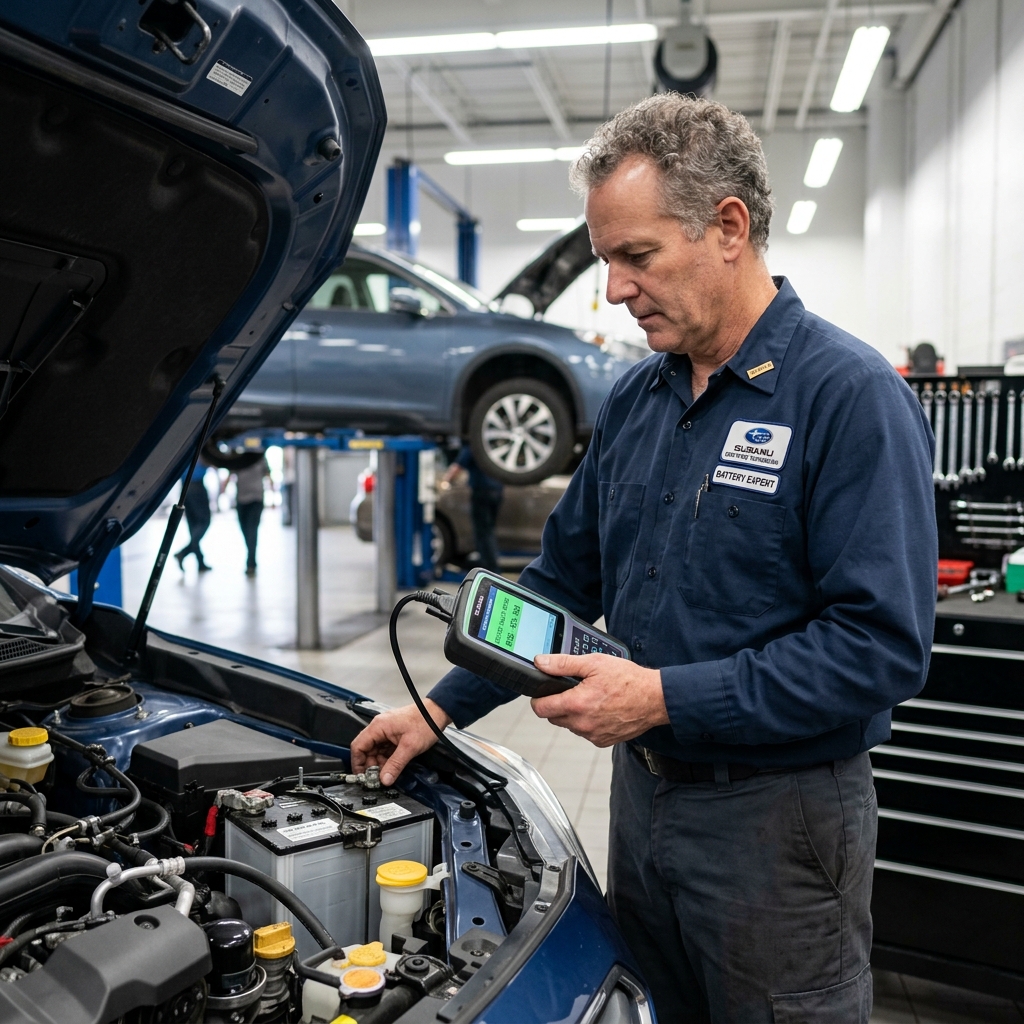
Table of Contents
- Testing Intervals and DIY Battery Diagnostics at Home
- Choosing the Right Technology: EFB vs AGM Batteries for Modern Subaru Models
- Understanding Battery Replacement Costs and Professional Labor in Chicago
- Essential Procedures: Safe Jump-Starting Steps and DIY Replacement Tools
- Common Questions About Subaru Battery Health
- Stay Ahead of the Chicago Seasons
Testing Intervals and DIY Battery Diagnostics at Home
When I help customers walk through their seasonal maintenance checklist, I always recommend testing the battery at least once a year after it reaches its third anniversary. In a climate like Chicago, where temperature swings are extreme, a battery that seems healthy in the spring may be marginal by autumn. Modern vehicles like the 2026 Subaru Forester are equipped with advanced systems like EyeSight® Driver Assist Technology, which requires a stable voltage supply to function correctly. If your battery is struggling, you might notice erratic behavior in these safety systems or dimming dashboard lights during the initial engine crank.
You can perform a basic health check at home using a digital multimeter. With the engine off and the vehicle resting for at least an hour, a fully charged battery should show a reading between 12.4 and 12.7 volts. If the reading drops below 12.2 volts, the battery is not maintaining a full charge and may need a professional load test. Additionally, owners can use the MySubaru app to view a Vehicle Health Report, which provides a status update on the battery's condition based on the vehicle's onboard diagnostics.
Beyond voltage readings, a physical inspection can reveal early warning signs of trouble. Look for a white, powdery substance around the terminals, which indicates corrosion that can restrict the flow of electricity. Ensure the battery hold-down bracket is tight, as excessive vibration can damage the internal components of the battery. If you notice a "swollen" battery case or a persistent sulfur smell, these are signs of internal damage that require immediate attention. To ensure your vehicle remains reliable for your daily commute, you can book a professional battery diagnostic with our expert team.
Choosing the Right Technology: EFB vs AGM Batteries for Modern Subaru Models
Modern Subaru vehicles often come equipped with specific battery technologies designed to handle high electrical loads and frequent start-stop cycles. The two primary types you will encounter are EFB (Enhanced Flooded Battery) and AGM (Absorbent Glass Mat) batteries. An EFB is an entry-level upgrade over a standard wet-cell battery, featuring a poly-fleece material that helps the lead plates stay active longer, which is ideal for basic Auto Start-Stop systems found in the 2026 Subaru Crosstrek.
For vehicles with higher power demands, an AGM battery offers superior performance. These batteries use a glass mat separator to absorb the electrolyte, making them spill-proof and highly resistant to vibration. They charge faster and have better deep-cycle capabilities, which is crucial if you frequently use accessories like heated seats or a heated steering wheel. When replacing a battery, it is vital to match the original specifications; installing a standard lead-acid battery in a vehicle designed for an AGM can lead to premature failure and potential charging system issues.
Our parts department stocks genuine Subaru batteries that are specifically engineered for the charging profiles of your vehicle's alternator. Choosing the correct technology ensures that your 4WD system and safety features receive consistent power regardless of the outside temperature. To help manage the cost of these high-performance components, we encourage you to view our current maintenance and parts specials before your next visit.
Understanding Battery Replacement Costs and Professional Labor in Chicago
The cost of a battery replacement for a 2026 Subaru Outback or similar model typically ranges between $180 and $350 for the part itself, depending on whether your vehicle requires an EFB or a high-output AGM unit. Labor costs for installation generally fall between $50 and $100 at a certified service center. While a battery swap might seem like a simple task, professional installation is recommended for modern vehicles because the engine control module often needs to be "relearned" or registered to the new battery to optimize the charging rate and preserve the life of the new component.
Our technicians also use a memory saver during the replacement process. This tool maintains a small amount of electrical current to the vehicle's computer while the battery is disconnected, preserving your radio presets, seat positions, and, most importantly, the calibration data for systems like EyeSight®. Without this, you may experience a rough idle or system errors immediately after a DIY replacement. To ensure you are getting the right component for your specific trim, you can request genuine Subaru parts directly from our team.
Investing in a high-quality battery and professional installation provides peace of mind during the unpredictable weather transitions in Rogers Park. A cheap, off-brand battery may save money upfront but often lacks the cold-cranking capacity needed for a reliable start on a sub-zero morning. For those considering a new vehicle with the latest battery and charging technology, we invite you to explore our current vehicle offers to see the newest models in our lineup.
Essential Procedures: Safe Jump-Starting Steps and DIY Replacement Tools
If you find yourself with a dead battery, jump-starting your Subaru requires a specific sequence to protect the sensitive electronics. First, ensure both vehicles are turned off and the parking brakes are engaged. Connect the red positive (+) clamp to the positive terminal of the dead battery, then connect the other red clamp to the positive terminal of the booster battery. Next, connect the black negative (-) clamp to the negative terminal of the booster battery. Finally, attach the last black clamp to an unpainted metal surface on the engine block of the dead vehicle—never to the negative terminal of the dead battery itself, as this can cause a spark near explosive gases.
If you are uncomfortable performing a jump-start or are stranded without help, remember that your vehicle includes a 3-year / 36,000-mile roadside assistance warranty. For exclusive manufacturer-backed assistance, you can contact Subaru Roadside Assistance: 1-800-261-2155. They provide brand-specific expertise and can coordinate a tow to our authorized service center if the battery cannot be revived.
For those who prefer to handle a replacement at home, you will need a few basic tools:
- Safety glasses and acid-resistant gloves
- A 10mm wrench or socket set for the terminal nuts
- A terminal cleaning tool or wire brush
- A memory saver (optional but recommended)
Always remove the negative cable first and install it last to prevent accidental short circuits. If you encounter any difficulties during the process or need a professional to take over, you can call 708-943-9726 for guidance or to arrange a service visit. For a full inspection of your charging system, you can also drop by our Irving Park Road facility to speak with a technician.
Common Questions About Subaru Battery Health
Q: How often should I have my battery load-tested?
We recommend a professional load test once a year after the battery is three years old. While a multimeter can tell you the resting voltage, a load test measures how the battery performs under the stress of starting the engine. This is the only way to identify a battery that has sufficient voltage but lacks the "muscle" to crank the engine in extreme temperatures.
Q: Why does my Subaru require an EFB or AGM battery instead of a standard one?
Modern Subaru models use sophisticated charging systems and Auto Start-Stop technology that puts significantly more strain on the battery than older vehicles. Standard lead-acid batteries are not designed to handle the frequent discharge and rapid recharge cycles of these systems. Using the wrong battery type can cause the Start-Stop system to malfunction and will likely result in the battery failing within a few months.
Q: Can I replace my own battery without losing my saved settings?
It is possible if you use a "memory saver" device that plugs into your OBD-II port or cigarette lighter. This device uses a small 9V battery or an external power source to keep the vehicle's computers energized while the main battery is disconnected. Without this, your vehicle may lose its idle speed calibration, window auto-up functions, and safety system settings.
Q: What should I do if I see corrosion on my battery terminals?
Corrosion acts as an insulator and can prevent your alternator from fully charging the battery. You can clean it at home using a mixture of baking soda and water with a stiff brush. However, persistent corrosion often indicates that acid is leaking from the battery posts, which is a sign that the battery is reaching the end of its life and should be replaced soon.
Q: Does the MySubaru app show me the exact battery voltage?
The MySubaru app provides a "Vehicle Health Report" that categorizes your battery status as "Normal" or "Action Required." While it doesn't typically show a live digital voltage readout, it monitors the battery's performance over time and will alert you if the charging system detects a decline in health before you get stranded.
Stay Ahead of the Chicago Seasons
Maintaining your battery is one of the simplest ways to ensure your Subaru remains the reliable companion you need for urban commuting and weekend adventures. Whether you are dealing with the intense heat of a Chicago summer or preparing for the sub-zero mornings of winter, a healthy charging system is your first line of defense. Our team is here to provide the expert diagnostics and genuine parts required to keep your vehicle performing at its peak. If you have noticed a slow start or simply want the peace of mind that comes with a professional inspection, we encourage you to schedule your battery health check online today.
© 2026 Berman Subaru of Chicago. All rights reserved.