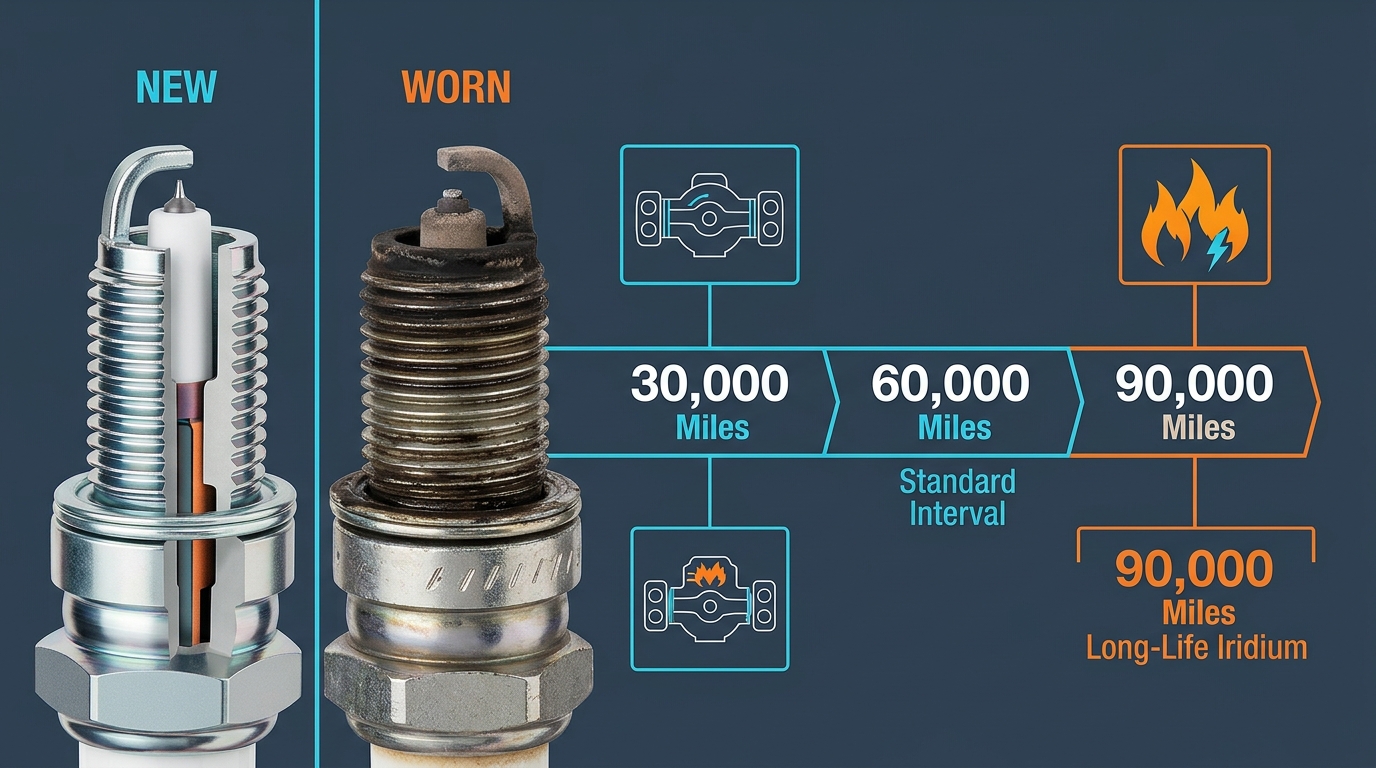
For most late-model Subaru vehicles equipped with naturally aspirated or turbocharged boxer engines, factory guidelines recommend replacing spark plugs every 60,000 miles or 60 months, whichever comes first. Older turbocharged engines often require replacement every 30,000 miles [1], while select naturally aspirated models using long-life iridium plugs may stretch to 90,000 miles under ideal conditions.
The horizontally opposed boxer layout present in models like the Outback, Forester, Crosstrek, and Ascent places unique demands on ignition components. Modern Subaru engines utilize a waste-spark configuration where the plugs fire on both the compression and exhaust strokes. This dual-firing cycle means electrode wear occurs at roughly twice the rate of a conventional inline engine over equivalent mileage. Sticking strictly to the 60,000-mile interval preserves optimum engine efficiency and prevents unexpected ignition failure.
Driving conditions significantly influence how quickly spark plug electrodes wear down. Frequent short trips, extended idling in urban stop-and-go traffic around Irving Park, cold winter starts, and heavy towing create severe operating conditions. Extended idling accelerates carbon deposits on the ceramic insulator and electrodes. This buildup narrows the spark pathway, leading to incomplete fuel combustion and reduced engine performance over time.
Adhering to factory service schedules ensures that ignition system output remains balanced across all cylinders. You can easily plan your visit to our convenient service center or speak with a service advisor directly by giving us a quick call to verify your vehicle's specific maintenance timeline.
Table of Contents
- What Are the Signs of Worn Spark Plugs and OBD-II Misfire Codes in a Subaru?
- Do You Have to Unbolt the Engine to Replace Subaru Spark Plugs and How Difficult Is DIY?
- How Much Does Subaru Spark Plug Replacement Cost in Chicago?
- How Do You Choose a Subaru Repair Shop and What Should You Ask Before Booking?
- Questions Owners Ask About Subaru Spark Plug Care
- Schedule Certified Subaru Ignition Care at Berman Subaru
What Are the Signs of Worn Spark Plugs and OBD-II Misfire Codes in a Subaru?
Worn or fouled spark plugs in a Subaru typically cause subtle engine stumbles, hesitation during acceleration, rough idling, reduced fuel economy, and diagnostic trouble codes ranging from P0300 to P0304.
As spark plug electrodes erode, the gap between the center and ground electrode widens. This enlarged gap requires the ignition coil to generate significantly higher voltage to arc across the space. When the coil cannot meet this demand, unburned fuel passes through the combustion chamber, causing the engine control unit to log cylinder misfire codes. Diagnostic code P0300 indicates a random or multiple cylinder misfire, while codes P0301, P0302, P0303, and P0304 pinpoint misfires in cylinders 1, 2, 3, or 4 respectively.
Subaru vehicles feature a distinct fail-safe response when an active misfire occurs. The Check Engine Light illuminates steadily or flashes, while the Cruise Control indicator begins flashing rapidly. To safeguard the drivetrain and occupant safety, the vehicle computer temporarily disables EyeSight Driver Assist Technology and traction control systems. This protective measures framework prevents automated speed adjustments when the engine operates erratically. Maintaining proper spark plug condition keeps these advanced driver-assist systems active and fully functional during hazardous winter drives near the Rogers Park waterfront.
Ignoring a misfiring spark plug risks severe downstream mechanical damage. Uncombusted fuel entering the exhaust stream flows into the catalytic converter. Superheated exhaust temperatures cause raw fuel to ignite within the converter's delicate honeycomb substrate, potentially melting internal components and turning a minor maintenance job into an expensive exhaust repair.
Do You Have to Unbolt the Engine to Replace Subaru Spark Plugs and How Difficult Is DIY?
Replacing Subaru spark plugs does not require unbolting or lifting the engine, but the restricted lateral space between the horizontal cylinder heads and the vehicle frame rails makes the task a challenging DIY project.
Because the boxer engine lays flat, the spark plug wells face sideways toward the inner body structures. Clearance between the valve covers and the frame rail is often limited to three or four inches. To gain access, technicians must first remove engine bay accessories, including the air intake assembly, battery, and washer fluid reservoir. Specialized hand tools—such as a slim-profile 16 mm spark plug socket with a magnetic retainer, short 3-inch extensions, wobble joints, and a flex-head ratchet—are mandatory to navigate these tight angles.
When our technicians walk drivers through a 60,000-mile service, owners often ask whether the engine has to be pulled just to reach the back cylinders. While some home mechanics attempt the job without lifting the engine, professional technicians occasionally loosen the lower engine pitch-mount bolts and raise the block roughly one inch with a jack to gain critical hand room.
Cross-threading is the primary risk during DIY installation. Subaru cylinder heads are constructed from cast aluminum alloy, which easily strips if steel spark plug threads enter at an angle. Stripping cylinder head threads causes compression leaks and requires extensive engine teardown to repair. Plugs must be started carefully by hand using a flexible rubber hose attached to the terminal before being torqued to the factory specification of 15 to 22 ft-lb on dry threads. Before installing new plugs, compressed air should clear grit from the plug wells, and dielectric grease should be applied inside the ignition coil boots to stop moisture intrusion.
How Much Does Subaru Spark Plug Replacement Cost in Chicago?
A professional Subaru spark plug replacement in the area typically costs between $350 and $650, with labor accounting for the majority of the total invoice due to the time required to work around tight frame clearances.
Parts costs vary based on the specific engine architecture and spark plug metallurgy. Modern Subaru models, including 2024 and newer editions using the 2.5L FB25 engine, come equipped from the factory with premium laser iridium spark plugs like the NGK SILZKR7B11 reference. Iridium features a melting point of roughly 2,400 degrees Celsius, enabling an ultra-thin center electrode wire that delivers a hot, precise spark under high compression. While high-durability iridium plugs carry a higher unit price than copper or standard platinum alternatives, their thermal resistance is necessary to survive modern combustion pressures.
Labor costs reflect the specialized procedure needed to service flat-four and flat-six engines. A standard inline-four engine allows direct overhead access to the spark plugs, often taking less than an hour to service. Conversely, a Subaru boxer engine requires two to three hours of detailed labor to remove engine bay obstructions, extract the ignition coil packs, hand-thread four or six plugs in tight clearances, and torque every plug precisely to factory specifications.
Using genuine factory parts guarantees correct heat ranges, precise pre-set electrode gaps, and exact thread reach. Owners interested in completing their own maintenance can ensure complete compatibility by ordering genuine Subaru parts online directly through our dedicated components department.
How Do You Choose a Subaru Repair Shop and What Should You Ask Before Booking?
Selecting a repair facility for boxer engine maintenance requires verifying technician certifications, specialized tool availability, and transparent service warranties.
When evaluating repair options, look for shops staffed by ASE-certified technicians who possess direct experience with horizontally opposed engines. Because Subaru ignition systems interface directly with engine management and safety electronics, improper torque or incorrect plug gaps can trigger secondary fault codes. A qualified facility uses calibrated torque wrenches, factory diagnostic scan tools, and OEM-spec components to protect powertrain integrity.
Before booking your maintenance appointment, ask the service department or shop advisor the following specific questions:
- Do your technicians use factory-recommended iridium spark plugs matched to my exact engine code?
- Does your labor estimate cover a full inspection of the ignition coil boots and spark plug tube seals?
- Are all replacement parts and labor backed by a clear written warranty?
- Does the quote include clearing stored diagnostic trouble codes and performing a post-service road test?
When requesting an estimate, provide the precise year, model, and engine displacement of your vehicle. Rather than diagnosing the vehicle yourself, describe any observable symptoms—such as a cold-start stumble or a flashing cruise control light. This enables the advisor to estimate labor times accurately and check for relevant technical service bulletins. You can reserve a convenient time for your maintenance milestone when you schedule your service appointment online with our team.
Questions Owners Ask About Subaru Spark Plug Care
Q: Can spark plugs last up to 100,000 miles in a Subaru?
While modern OEM laser iridium spark plugs can physically survive up to 90,000 or 100,000 miles in naturally aspirated engines under ideal highway conditions, running them past the 60,000-mile factory recommendation is not advised. Over extended mileage, electrode erosion widens the plug gap, forcing ignition coils to operate under high electrical stress, which increases the likelihood of coil failure and sudden misfires.
Q: What type of spark plugs does a 2024 Subaru use?
Most 2024 Subaru models with naturally aspirated 2.5-liter engines use factory-installed laser iridium spark plugs, such as the NGK SILZKR7B11. Turbocharged models utilize high-heat iridium plugs designed specifically to withstand higher cylinder pressures and elevated thermal conditions.
Q: Why is anti-seize compound not recommended on new Subaru spark plugs?
Modern OEM spark plugs feature a special trivalent zinc or nickel plating on the metal threads that provides built-in corrosion resistance. Applying anti-seize lubricant reduces thread friction during installation, which can alter torque wrench readings and lead to over-tightening, potentially cracking the aluminum cylinder head.
Q: What happens if a spark plug is cross-threaded during installation?
Cross-threading forces the steel spark plug threads against the soft aluminum threads of the cylinder head at an incorrect angle, stripping the delicate head threads. This destroys the combustion seal, resulting in loss of compression and requiring expensive thread insert repairs or a complete cylinder head replacement.
Q: How long does a professional spark plug replacement service take?
Because of the restricted space between the cylinder heads and the vehicle frame rails, a factory-trained technician typically requires two to three hours to remove intake and electrical components, service all four spark plug wells, hand-thread the new plugs, torque them to spec, and perform a final diagnostic scan.
Schedule Certified Subaru Ignition Care at Berman Subaru
Keeping your boxer engine's ignition system properly maintained is vital for preserving the smooth power delivery, winter starting reliability, and long-term fuel efficiency you expect. Following factory replacement intervals protects your catalytic converter and ensures advanced EyeSight technologies remain active and dependable.
Our factory-trained technicians at Berman Subaru of Chicago possess the specialized equipment, thin-profile tools, and genuine OEM parts required to handle the tight spatial tolerances of flat-engine maintenance. Whether your vehicle is approaching its 60,000-mile service milestone or displaying a Check Engine Light, our team provides transparent guidance and expert care tailored to your exact model.
When it is time for routine maintenance or ignition system diagnostics, visit our service center on West Irving Park Road or contact our service team directly at (708) 943-9726 to keep your Subaru running smoothly.
© 2026 Berman Subaru of Chicago. All rights reserved.