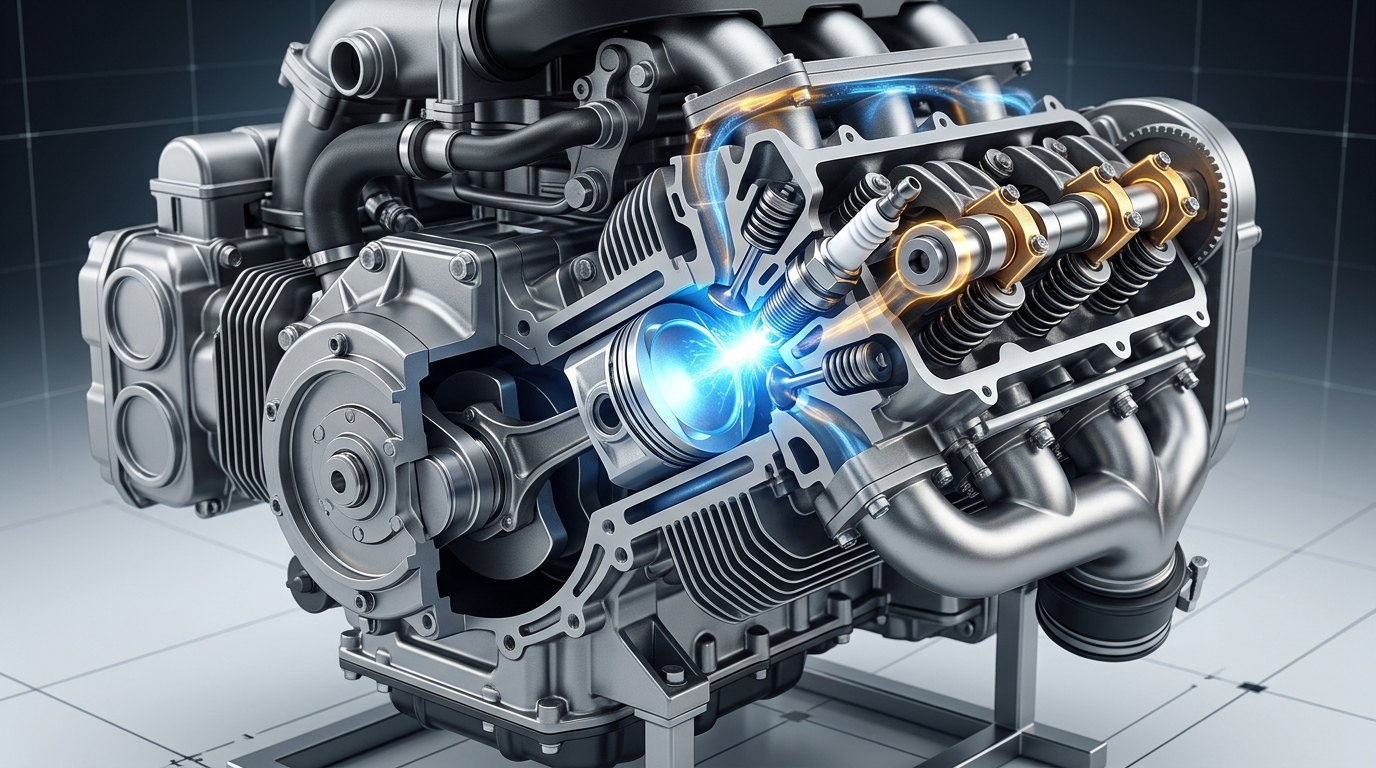
Every Subaru vehicle relies on its horizontally opposed engine layout to provide a low center of gravity and balanced handling, but this unique configuration also dictates a specific maintenance rhythm. For most late-model Subaru boxer engines, including the naturally aspirated and turbocharged FB and FA engine families, the factory-recommended spark plug replacement interval is 60,000 miles or 60 months, whichever occurs first. This timeline is especially critical because modern Subaru boxer engines utilize a waste-spark system where the plugs fire on both the compression and exhaust strokes. This dual-firing cycle means the electrodes experience twice the wear of a standard engine configuration over the same mileage.
Ignoring this interval can slowly degrade your vehicle's efficiency and winter-weather reliability. For example, drivers navigating the frequent stop-and-go traffic in Irving Park often experience increased idling times, which can accelerate carbon fouling on the electrodes. Over time, this buildup restricts the electrical arc, leading to weak combustion and sluggish performance. Whether you drive a 2026 Subaru Outback or a Forester, keeping up with this major service milestone is essential for preserving the longevity of your powertrain.
If you plan to tackle this maintenance project yourself, you can order genuine Subaru parts directly through our website to ensure you receive the exact factory-specified components. For owners who prefer professional calibration and care, you can reach our service advisors by giving us a quick call or by planning a visit to our convenient location on Irving Park Road.
Table of Contents
- The Technical Specs: Iridium Spark Plugs and Precision Gap Requirements for Subaru Engines
- Navigating the Tight Clearance: Tools and Techniques for Accessing Subaru Spark Plugs
- How Bad Spark Plugs Trigger Check Engine and Flashing Cruise Control Lights in a Subaru
- Professional Service Costs and Powertrain Warranty Considerations for Subaru Owners
- Troubleshooting Persistent Misfires and Confirming Your Subaru Repair Is Complete
- Common Maintenance Questions About Subaru Spark Plugs
- Keep Your Subaru Performing at Its Best on the Road
The Technical Specs: Iridium Spark Plugs and Precision Gap Requirements for Subaru Engines
While older vehicles frequently utilized standard copper or single-platinum plugs, modern Subaru engineering demands a much more robust material to handle high cylinder pressures. The 2.5L FB25 engine found in the 2026 Subaru Forester and the 2026 Subaru Crosstrek is factory-equipped with high-durability iridium-tipped spark plugs, typically the NGK SILZKR7B11 reference. Iridium boasts an incredibly high melting point of roughly 2,446 degrees Celsius, allowing the center electrode to be designed with an ultra-fine wire profile. This narrow tip concentrates the electrical discharge, creating a hotter, more consistent spark that ensures complete combustion even under heavy load.
Maintaining the precise electrode gap is critical to preventing ignition failure. For most naturally aspirated Subaru boxer engines, the factory-specified spark plug gap is tightly controlled to ensure optimal ignitability. While these premium plugs arrive pre-gapped from the manufacturer, shipping vibrations or handling can occasionally nudge the ground electrode out of alignment. Technicians use a precision feeler gauge to verify the gap before installation, taking extreme care not to scrape or apply pressure to the fragile iridium center tip, which can easily fracture under mechanical stress.
If you are researching the latest engineering updates on newer models, checking our new vehicle specials can give you an idea of the advanced engine technologies currently available across the latest lineup. Whether you are driving a brand-new model or maintaining a trusted high-mileage vehicle, utilizing the exact OEM-specified spark plug is the only way to guarantee the engine operates within its designed parameters.
Navigating the Tight Clearance: Tools and Techniques for Accessing Subaru Spark Plugs
Have you ever looked inside a Subaru engine bay and wondered how anyone accesses the spark plugs? Because of the horizontal boxer layout, the cylinder heads are positioned sideways, facing directly toward the vehicle's structural frame rails. This leaves only a few inches of clearance between the ignition coil packs and the metal body of the car, making the replacement process significantly more challenging than on an inline-four engine. While you do not strictly have to lift or jack up the engine to complete the job, some professional technicians choose to loosen the lower engine mount bolts and gently raise the engine by about an inch using a floor jack to gain valuable working room.
To navigate this tight space successfully without cross-threading the cylinder heads, having a highly specialized tool kit is essential. A standard deep socket will not suffice; instead, a dedicated 16 mm spark plug socket with a magnetic retainer or rubber insert is required to hold the plug secure. You will also need a combination of short 3-inch and 6-inch wobble extensions, a locking flex-head ratchet, and a calibrated torque wrench. Because Subaru uses aluminum cylinder heads, over-tightening can easily strip the soft metal threads, while under-tightening allows combustion gases to leak. Always torque the new plugs to the factory specification of 15 to 22 ft-lb on dry threads.
Before inserting the new plugs, always blow compressed air into the spark plug wells to clear away any accumulated road grit, oil, or debris. Once the old plug is unthreaded, technicians apply a small dab of dielectric grease to the inside of the rubber ignition coil boot. This non-conductive silicone barrier prevents moisture from intruding and stops the boot from baking onto the ceramic insulator over years of heat cycles.
How Bad Spark Plugs Trigger Check Engine and Flashing Cruise Control Lights in a Subaru
A sudden dashboard warning in a Subaru often presents a unique and alarming behavior: the check engine light illuminates steadily while the cruise control indicator begins flashing rapidly. This synchronized warning is a standard Subaru programming protocol designed to protect the vehicle's drivetrain and advanced safety systems. When a worn or fouled spark plug fails to ignite the air-fuel mixture, the engine control unit detects a misfire and logs diagnostic trouble codes such as P0301 or P0303. To prevent the driver from engaging automated driving functions while the engine is running unevenly, the vehicle temporarily disables the EyeSight Driver Assist Technology and traction control, triggering the flashing dashboard indicators.
This safety system is particularly vital during freezing winter commutes near the Rogers Park shoreline, where a sudden loss of traction control or engine power on icy streets could compromise your safety. A misfiring cylinder allows raw, unburned gasoline to escape directly into the exhaust system. When this raw fuel reaches the extremely hot substrate of the catalytic converter, it ignites inside the exhaust, rapidly overheating and melting the internal components. What begins as a minor ignition issue can quickly escalate into a costly catalytic converter replacement if ignored.
If you experience a flashing check engine light, it indicates an active, severe misfire that is actively damaging the emissions system. Under these conditions, you should minimize driving and have the vehicle inspected immediately. Swapping out worn plugs before they reach this point of failure ensures that your vehicle's safety systems remain fully operational and ready to handle challenging road conditions.
Professional Service Costs and Powertrain Warranty Considerations for Subaru Owners
Many owners wonder if they can save on maintenance costs by installing aftermarket spark plugs at home, but this decision requires weighing both mechanical complexity and warranty protections. Under federal law, using high-quality aftermarket spark plugs will not automatically void your Subaru five-year or 60,000-mile powertrain warranty. However, if an incorrect or substandard aftermarket plug fails—such as an electrode breaking off and falling into the combustion chamber—any resulting engine damage will not be covered by the manufacturer. For this reason, utilizing factory-certified components is always the safest path to protect your vehicle's warranty and long-term reliability.
While a highly patient owner with a robust set of specialized hand tools can theoretically perform a DIY replacement, the tight clearances of the boxer engine make it a frustrating and time-consuming process for beginners. Professional service at a dealership ensures that the plugs are torqued precisely, the ignition coils are inspected for hairline cracks, and the delicate plug wells are thoroughly cleaned. Our factory-trained technicians perform this service daily, utilizing specialized slim-profile tools designed specifically to clear the frame rails without risking damage to the cylinder heads.
To keep your maintenance budget on track, we regularly update our online service specials with competitive offers on major maintenance milestones. When your vehicle is approaching its next major interval, you can easily schedule your service today using our online portal to ensure your vehicle receives expert care from certified professionals who understand the unique engineering of your boxer engine.
Troubleshooting Persistent Misfires and Confirming Your Subaru Repair Is Complete
Imagine completing a meticulous spark plug replacement only to start the engine and find that the persistent misfire remains. If your vehicle continues to idle roughly or throw misfire codes after installing fresh plugs, the issue likely lies within the surrounding ignition or fuel delivery systems. The most logical diagnostic step is to perform a coil swap test. By moving the ignition coil from the misfiring cylinder to a functioning cylinder, clearing the codes, and re-scanning the engine, you can determine if the fault lies with the coil itself. If the misfire code follows the coil to the new cylinder, the ignition coil has failed and must be replaced.
Another common culprit behind persistent ignition issues is oil contamination within the spark plug wells. During the removal process, if you notice the rubber coil boot or the old spark plug is coated in engine oil, this indicates that the spark plug tube seals or the valve cover gasket have degraded. Oil is highly conductive and will cause the electrical current to arc through the boot to the cylinder head rather than jumping the spark plug gap, resulting in a constant misfire. Replacing the seals is necessary to prevent the new plugs from being compromised.
To confirm that your ignition system is fully restored, our technicians clear the stored ECU memory and perform a comprehensive road test under varied driving conditions, monitoring live misfire counters to ensure they remain at zero. If you need assistance diagnosing a stubborn engine stumble, you can obtain turn-by-turn guidance by viewing directions to our service center or contact our advisors directly at (708) 943-9726 to discuss your vehicle's symptoms.
Common Maintenance Questions About Subaru Spark Plugs
Q: Do turbocharged Subaru models require more frequent spark plug changes than naturally aspirated ones?
Turbocharged models experience much higher combustion temperatures and cylinder pressures, which places greater thermal stress on the electrodes. While many modern turbocharged FA-series engines still specify a 60,000-mile interval, older EJ-series turbo engines often require replacements every 30,000 miles to prevent high-load misfires.
Q: Should I apply anti-seize compound to the threads of my new Subaru spark plugs?
Most modern OEM spark plug manufacturers, including NGK, explicitly advise against using anti-seize on plated threads. The lubricant alters the torque-to-clamp-force ratio during installation, which can easily lead to over-torquing and cracking the aluminum cylinder head threads.
Q: Can a bad spark plug cause my Subaru's fuel economy to drop suddenly?
Incomplete combustion from a worn or improperly gapped plug forces the engine control unit to adjust fuel trim levels, often running rich to compensate. This inefficient combustion can reduce your overall fuel economy by up to 30 percent over time.
Q: How can I tell if my spark plug boots need to be replaced along with the plugs?
Inspect the rubber boots of your ignition coils closely for small hairline cracks, dry rot, or white carbon tracking lines. If the rubber is brittle or shows signs of electrical arcing, replacing the boots or the entire coil assembly is necessary to prevent misfires.
Q: What is the typical turnaround time for a professional spark plug replacement at the dealership?
Because of the tight clearance and specialized tools required to access the horizontally opposed cylinders, a professional technician typically completes a full spark plug replacement in about two to three hours.
Keep Your Subaru Performing at Its Best on the Road
Maintaining the precise ignition timing of your boxer engine is one of the most effective ways to preserve the smooth idle, responsive acceleration, and excellent fuel economy of your vehicle. Staying ahead of the factory maintenance schedule protects your catalytic converter and ensures that advanced safety features like EyeSight remain fully active. Our team of factory-trained technicians is equipped with specialized tools and genuine OEM parts to handle the unique mechanical layout of your vehicle with absolute precision.
Whether you are noticing a slight stumble at idle or preparing your vehicle for another demanding winter season, we are here to provide transparent guidance and expert care. Let our certified team handle the tight clearances and technical calibrations of your next major service milestone. Use our online scheduling tool to secure a convenient time for your next maintenance visit, or contact our service advisors today to keep your engine running smoothly for miles to come.
© 2026 Berman Subaru of Chicago. All rights reserved.