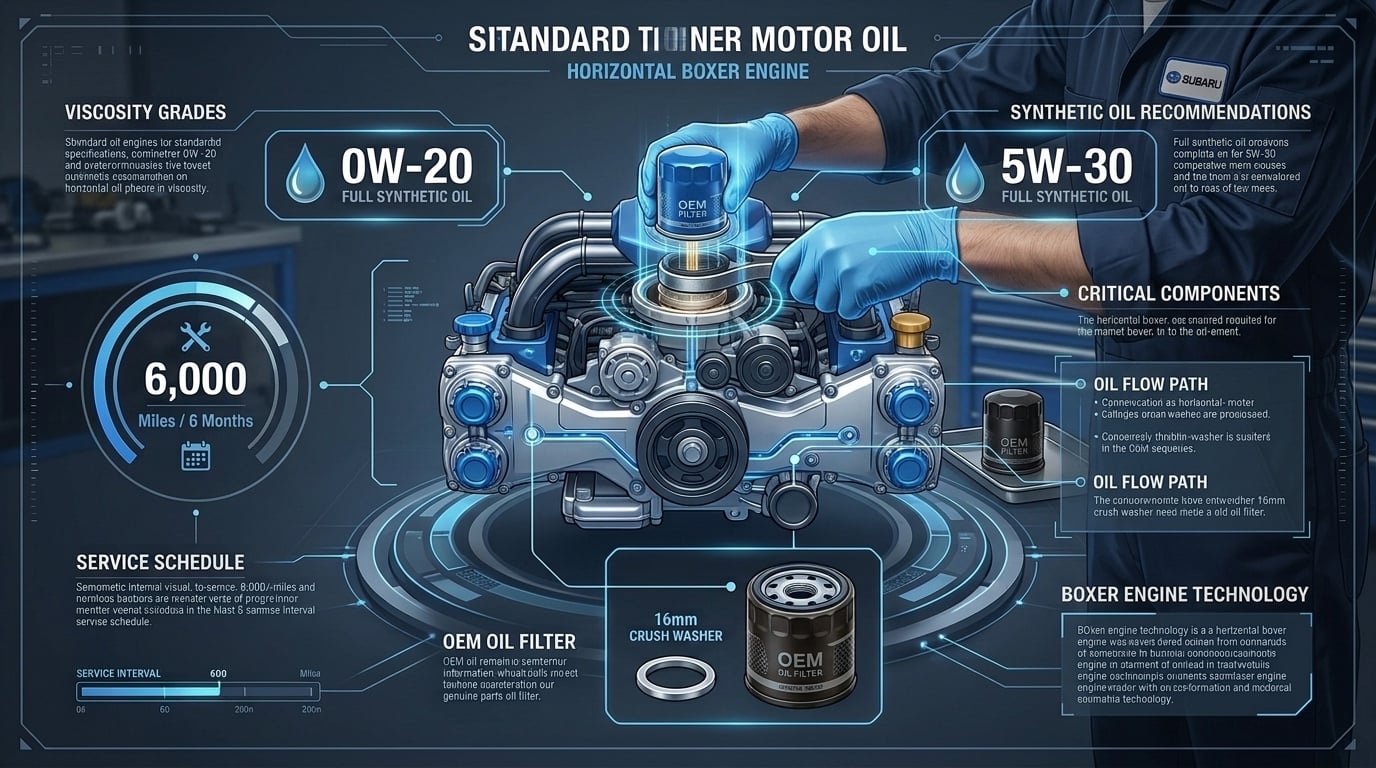
Subaru specifies full synthetic 0W-20 or 5W-30 motor oil meeting API SP / ILSAC GF-6A standards, paired with a genuine OEM oil filter and a replacement 16mm crush washer. Standard maintenance requires a complete oil and filter change every 6,000 miles or 6 months, whichever comes first. Vehicles driven under severe operating conditions require shortened intervals between 3,000 and 3,750 miles to preserve engine longevity and protect critical boxer engine components.
Factory maintenance guidelines emphasize that engine oil must meet the precise viscosity and certification standards outlined in your owner’s manual, such as OEM specification SOA868V1. Modern Subaru models equipped with FB20, FB25, and FA24 boxer engines feature a top-mounted oil filter assembly designed for efficient oil flow and rapid oil pressure buildup during cold startups. Using genuine Subaru engine oil ensures proper lubrication across horizontal cylinder walls and active valve-control systems.
Adhering to both time and mileage intervals is essential for maintaining powertrain health. Engine oil breaks down over time due to thermal cycling, oxidation, and fuel dilution, even when total vehicle mileage remains low. Drivers navigating frequent short trips along Irving Park Road during cold winter months subject their engines to repeated cold starts, preventing the oil from reaching optimal operating temperature to burn off condensation.
When your vehicle is due for routine maintenance, visiting our Irving Park service center location ensures your engine receives certified factory care. You can easily schedule your service appointment online or reach out to our service team directly at (708) 943-9726 to keep your vehicle ready for Chicago winters.
Table of Contents
- Which Subaru Engines Require 0W-20 Synthetic Oil Versus 5W-30?
- How Often Does a Subaru Need a Synthetic Oil Change Under Chicago Driving Conditions?
- How Much Is a Subaru Synthetic Oil Change and What Factors Drive Up Service Costs?
- Does Skipping Oil Changes Risk Expensive Engine Repairs or Void Your Warranty?
- What Tools and Washer Sizes Are Needed for DIY Oil Changes Versus Certified Dealer Care?
- Frequently Asked Questions About Subaru Oil Service
Which Subaru Engines Require 0W-20 Synthetic Oil Versus 5W-30?
Naturally aspirated Subaru engines, including the FB20 2.0-liter and FB25 2.5-liter, require ultra-low viscosity 0W-20 full synthetic oil to maximize fuel efficiency and cold-start protection. Turbocharged models, such as the FA24DIT 2.4-liter turbo found in the Outback XT, Ascent, and WRX, mandate 5W-30 full synthetic oil to withstand elevated operating temperatures and higher thermal stress.
The viscosity rating indicates how motor oil flows at different temperatures. The "0W" and "5W" designations describe cold-weather flow capability, where lower numbers allow immediate oil circulation to upper valvetrain components during sub-zero mornings. The second number ("20" or "30") measures high-temperature thickness. While 0W-20 reduces internal friction in non-turbo engines to support optimal fuel economy, turbocharged engines demand the thicker oil film of 5W-30 to protect high-rpm turbo bearings under heavy acceleration.
A common question among owners is whether 5W-30 oil can be used in an engine designed for 0W-20. While Subaru permits adding a quart of 5W-30 for temporary replenishment if 0W-20 is unavailable, a complete replacement with the factory-recommended 0W-20 full synthetic oil should be performed at the next service. Using the wrong viscosity long-term can reduce fuel efficiency and compromise tight internal bearing clearances.
Understanding your engine's specific fluid requirements helps maintain smooth performance whether you are navigating city traffic or heading out on weekend trips. Owners looking to keep their vehicles running smoothly can explore current maintenance offers and vehicle specials to stay up to date on recommended factory care.
How Often Does a Subaru Need a Synthetic Oil Change Under Chicago Driving Conditions?
Under severe driving conditions typical of urban environments, a Subaru requires a synthetic oil change every 3,000 to 3,750 miles or every 3 to 6 months. While standard factory guidelines recommend 6,000 miles, short trips under 5 miles, prolonged idling, extreme winter temperatures, and stop-and-go traffic degrade engine oil at an accelerated rate.
Subaru defines severe operating conditions by specific environmental and driving patterns. Operating a vehicle in ambient temperatures below 10°F or above 90°F, frequent stop-and-go driving during heavy congestion, extended idling, towing, or driving on dusty and salt-treated roads all fall under severe maintenance schedules. These conditions accelerate oil oxidation and increase unburned fuel contamination in the crankcase.
Lakefront commutes in Rogers Park illustrate how local driving habits meet severe service criteria. Vehicles driven on brief trips to nearby transit stations or parked near salt-treated winter roadways experience higher condensation inside the oil pan. Because short trips prevent the engine oil from reaching its full operating temperature of around 200°F, moisture and fuel remnants cannot evaporate, leading to premature oil breakdown and potential sludge formation.
Following a shortened maintenance schedule under severe conditions protects critical valvetrain components and preserves long-term engine performance. Changing synthetic oil every 3,000 to 3,750 miles ensures your boxer engine maintains steady oil pressure, clean internal galleries, and reliable cold-weather startup protection throughout every season.
How Much Is a Subaru Synthetic Oil Change and What Factors Drive Up Service Costs?
A standard full synthetic oil change for a Subaru generally costs by contacting our service team for current pricing, depending on engine displacement and oil capacity. Total service costs increase when servicing higher-capacity engines like the 3.6-liter 6-cylinder, turbocharged engines requiring specialized fluids, or when combining oil service with cabin air filter replacements and multi-point inspections.
Several operational factors influence overall service pricing during a maintenance visit:
- Engine Oil Capacity: Standard 2.0-liter and 2.5-liter 4-cylinder engines require roughly 4 to 5 quarts of oil, whereas 3.6-liter 6-cylinder and 2.4-liter turbo engines require larger fluid volumes.
- Oil Specification: Premium full synthetic oils formulated to meet API SP / ILSAC GF-6A standards carry higher fluid costs than conventional formulations but provide required protection.
- Combined Maintenance: Replacing engine air filters, cabin air filters, or tire rotations during the same appointment increases overall service totals while saving time.
- OEM Components: Genuine Subaru oil filters engineered with high-strength anti-drainback valves and precise bypass pressure settings cost slightly more than generic aftermarket filters.
When drivers ask our service team about maintenance costs for turbocharged models versus naturally aspirated crossovers, we explain that the higher fluid capacity and elevated thermal demands of turbo engines account for the small difference in service pricing. Choosing factory-trained service ensures your vehicle receives correct torque procedures, OEM parts, and a thorough multi-point vehicle inspection.
To help manage routine ownership expenses, drivers can review our service specials and maintenance coupons before booking their appointment. Choosing certified service delivers transparent maintenance care tailored specifically to your vehicle's engineering specs.
| Subaru Engine Type | Oil Viscosity Spec | Approx. Fluid Capacity | Standard Change Interval |
|---|---|---|---|
| 2.0L / 2.5L Naturally Aspirated | 0W-20 Full Synthetic | 4 to 5 Quarts | 6,000 Miles / 6 Months |
| 2.4L Turbocharged (FA24DIT) | 5W-30 Full Synthetic | 5 Quarts | 6,000 Miles / 6 Months |
| 3.6L 6-Cylinder (EZ36) | 5W-30 Synthetic Blend / Full Synthetic | 7 Quarts | 6,000 Miles / 6 Months |
Does Skipping Oil Changes Risk Expensive Engine Repairs or Void Your Warranty?
Skipping recommended oil changes directly risks severe internal engine damage, including camshaft bearing wear, variable valve timing failure, piston ring sticking, and complete engine seizure costing between $3,200 and $4,500 to repair. Furthermore, failing to perform required oil maintenance can result in denied warranty claims if engine failure occurs due to fluid neglect or oil starvation.
Subaru’s unique horizontally opposed boxer engine layout relies on constant, uniform oil flow to lubricate horizontally moving pistons and cylinder walls. Overaged oil loses its viscosity and resistance to thermal breakdown, leading to sludge accumulation inside narrow oil passages. Sludge starves variable valve timing actuators and turbocharger bearings, which can trigger low-oil pressure warnings and severe internal friction.
Neglecting regular oil maintenance can also compromise your vehicle's factory warranty protection. To maintain coverage under the factory warranty coverage, owners must follow factory maintenance intervals. While federal law permits owners to service their vehicles at qualified facilities outside of a dealership, you must keep detailed, verifiable records showing that oil meeting API SP / ILSAC GF-6A specifications was replaced at correct intervals.
Preventing costly mechanical issues starts with using factory-approved maintenance components. Drivers who perform their own maintenance or prefer OEM components can easily order genuine Subaru parts online, including official filters and crush washers, to keep their vehicle running reliably.
What Tools and Washer Sizes Are Needed for DIY Oil Changes Versus Certified Dealer Care?
A DIY Subaru oil change requires a 14mm socket or wrench, an oil filter wrench matching the top-mounted filter, an oil drain pan, a funnel, and a new 16mm OEM crush washer for the oil pan drain plug. While top-mounted filters make DIY service accessible, professional dealer care ensures precise drain plug torque (31.7 lb-ft), proper crush washer orientation, and safe oil disposal.
Performing a DIY oil change on modern FB and FA engines is straightforward thanks to the top-mounted oil filter located right at the front of the engine bay. The step-by-step DIY process involves:
- Safely elevating the vehicle on level ramps or jack stands and securing it with wheel chocks.
- Removing the oil pan drain plug using a 14mm socket and draining used oil into a catch pan.
- Removing the old crush washer and installing a new 16mm crush washer with the flat side facing the oil pan.
- Torquing the drain plug to factory spec (31.7 lb-ft) to prevent thread damage or oil pan leaks.
- Unscrewing the top-mounted filter, wiping the housing clean, lubricating the new OEM filter gasket with fresh oil, and hand-tightening.
- Refilling the engine with the exact volume of 0W-20 or 5W-30 synthetic oil and checking the dipstick level.
While DIY maintenance appeals to hands-on owners, certified dealership service offers clear operational advantages. Professional technicians perform a comprehensive multi-point health check, inspect steering and suspension boot integrity, check for outstanding safety recalls, and ensure used fluids are recycled according to local environmental standards.
Frequently Asked Questions About Subaru Oil Service
Q: Do independent mechanics in Chicago use genuine Subaru OEM oil and filters?
Most independent repair shops utilize aftermarket synthetic oils and generic oil filters that meet broad industry standards unless an OEM part is specifically requested. Genuine Subaru filters feature a proprietary bypass valve designed for proper oil flow, preventing oil starvation during cold winter startups—a specification many aftermarket filters do not match.
Q: What happens if I temporarily add 5W-30 oil to an engine requiring 0W-20?
Adding a quart of 5W-30 synthetic oil to top off an engine specified for 0W-20 will not cause immediate mechanical harm during emergency situations. However, because thicker oil slightly reduces fuel economy and alters cold-flow characteristics, Subaru recommends draining and refilling with the correct 0W-20 full synthetic oil at the earliest opportunity.
Q: How can I check if my Subaru engine is consuming oil between service visits?
Park your vehicle on flat ground, turn off the engine, and wait five minutes for oil to drain back into the pan. Pull the yellow dipstick, wipe it clean with a lint-free rag, reinsert it fully, and pull it out to inspect the level between the full and low pinholes. Checking every second fuel fill-up helps identify subtle level drops before low-oil warnings illuminate.
Q: Is time as important as mileage when scheduling a synthetic oil change?
Engine oil degrades over time through oxidation, thermal cycles, and fuel dilution, even if the vehicle accumulates low mileage. Short city drives prevent the engine from reaching full operating temperature, allowing moisture and unburned fuel to accumulate in the crankcase, making six-month oil replacements necessary regardless of distance driven.
Q: What is the crush washer and why must it be replaced with every oil change?
The crush washer is a single-use aluminum seal positioned between the oil pan drain plug and the oil pan. When torqued to spec, the metal deforms to create a leak-tight seal; reusing an old, compressed washer can lead to slow oil leaks or drain plug loosening over time.
Scheduling Your Next Subaru Oil Change Service
Maintaining regular oil change intervals is the single most effective step you can take to preserve your vehicle's reliability, fuel efficiency, and safety. Whether you drive a Crosstrek for daily urban commuting or an Outback for weekend road trips, certified factory maintenance protects your investment over every mile.
To keep your vehicle performing at its best, get directions to Berman Subaru of Chicago or give our service center a call at (708) 943-9726 to reserve your next routine maintenance visit today.
© 2026 Berman Subaru of Chicago. All rights reserved.