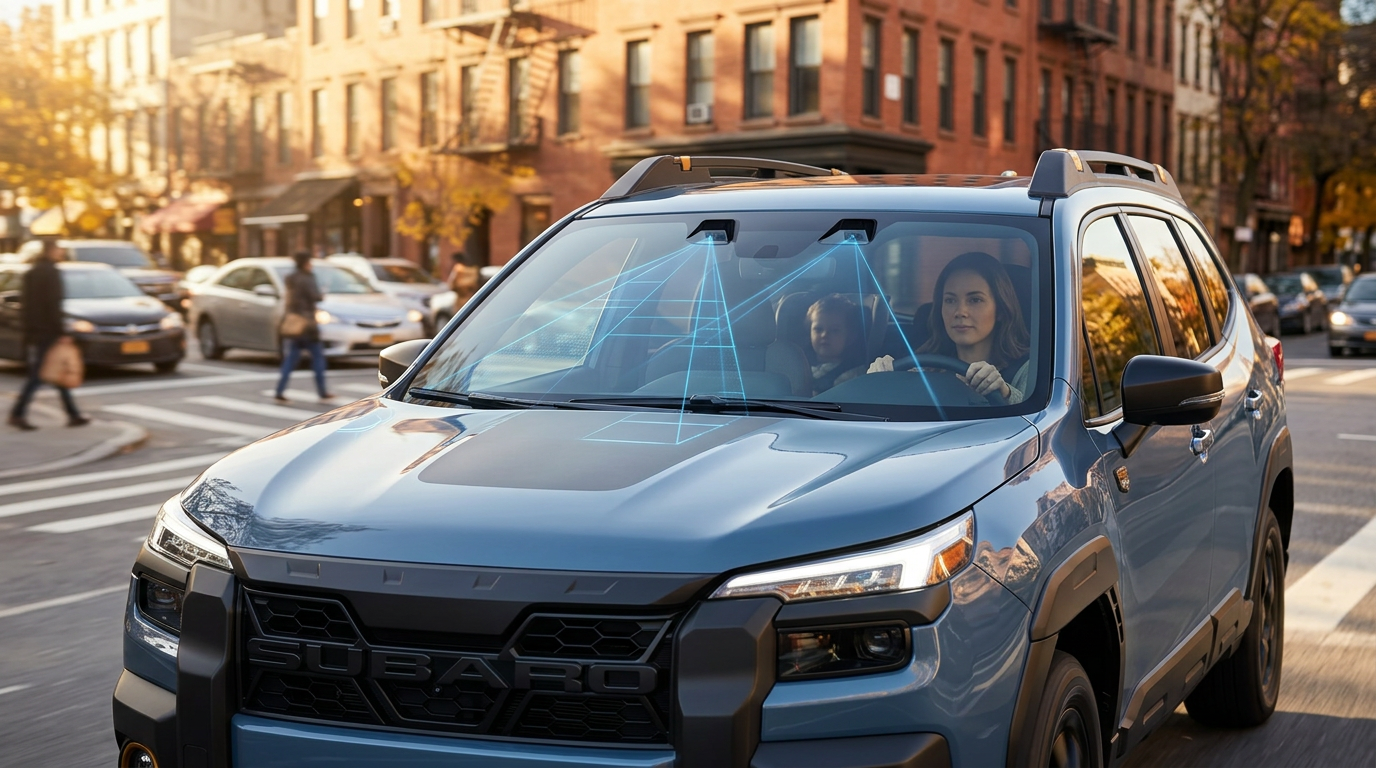
Driving through urban traffic requires constant vigilance, and the active safety features built into your vehicle act as an invaluable layer of protection. The EyeSight driver-assist technology serves as an extra set of eyes on the road, continuously monitoring traffic flow and road conditions to help prevent accidents before they occur. By actively tracking the movement of surrounding vehicles, this system provides drivers with heightened awareness during daily commutes and school drop-offs.
Navigating the busy intersections around the Irving Park Metra Station presents daily challenges that demand quick braking responses. When traffic stops abruptly, the Pre-Collision Braking system can detect the hazard ahead and automatically apply the brakes if the driver does not react in time. This critical intervention significantly reduces the severity of front-end collisions, helping to keep your family secure during sudden stop-and-go situations.
In addition to emergency braking, the system includes features like Lane Keep Assist and Adaptive Cruise Control to make highway driving less stressful. If your vehicle begins to drift out of its lane without a turn signal, the system provides a gentle warning and can even apply corrective steering to guide you back into place. To ensure these sophisticated safety systems remain operational, visit our service center on Irving Park Road or give our team a quick call to discuss your vehicle's maintenance needs.
Table of Contents
- The Hardware Behind the Mirror: How EyeSight Cameras and Sensors Detect Hazards
- Decoding Your Dashboard: What the Amber EyeSight Warning Light Signifies
- Windshield Replacement with EyeSight: Cost Factors and OEM Glass Requirements
- Why EyeSight Warning Lights Require Professional Calibration After Glass Replacement
- Common Questions About Subaru EyeSight Maintenance and Calibration
- Trust Berman Subaru for Certified EyeSight Diagnostics and Maintenance
The Hardware Behind the Mirror: How EyeSight Cameras and Sensors Detect Hazards
Are you curious about the specific components that allow your vehicle to monitor the road so effectively? Unlike many driver-assist systems that rely on radar sensors mounted in the front bumper, the EyeSight system utilizes dual color cameras positioned high on the windshield near the rearview mirror. These dual cameras function similarly to human eyes, capturing a three-dimensional stereoscopic view of the road ahead to measure distance, speed, and the size of objects in the vehicle's path.
The stereoscopic camera setup is engineered to recognize brake lights, pedestrians, cyclists, and painted lane markings. By analyzing the visual data from both camera lenses, the onboard computer can activate Pre-Collision Throttle Management to cut power to the engine if it detects an obstacle directly in front of the vehicle. This prevents accidental forward acceleration from a parked position. The system also monitors your vehicle's position within the lane to trigger the Lane Departure and Sway Warning if you begin to drift.
Because these cameras are optical devices, they require a completely clear field of view through the glass to operate correctly. Dirt, grime, or physical damage to the windshield directly blocks the lenses, which can cause the safety features to disable automatically. To keep your vehicle's sensors clean and properly aligned, you can take advantage of our routine maintenance offers to keep all your active safety systems in peak condition.
Decoding Your Dashboard: What the Amber EyeSight Warning Light Signifies
A sudden alert on your instrument cluster can cause immediate concern during your daily commute. Subaru dashboard warning lights are color-coded to help you determine the urgency of the issue: red indicators mean you should stop the vehicle as soon as it is safe, green or blue lights show that a system is currently active, and amber or yellow lights indicate that a system has been disabled or has detected a fault. An amber EyeSight warning light means the driver-assist system is temporarily offline and its safety interventions are unavailable.
When a driver brings a vehicle in because the EyeSight disabled light came on, our technicians usually look at the windshield glass first before plugging in diagnostic tools. The most common cause of a temporary system deactivation is a physical obstruction on the windshield, such as heavy snow, ice, condensation, or mud directly in front of the camera lenses. Extreme cabin temperatures can also cause the cameras to temporarily shut down to protect their internal processors. In these cases, clearing the glass or adjusting the climate control to cool or warm the cabin will usually resolve the issue, and the amber light will turn off once the cameras regain a clear view.
If the amber warning light remains illuminated after cleaning the windshield and driving in moderate weather, it indicates a persistent system fault that requires professional diagnostics. Ignoring a constant warning light means you are driving without the protection of Pre-Collision Braking or Adaptive Cruise Control. Ensuring these advanced safety systems are fully calibrated protects the long-term reliability of the vehicles featured in our new vehicle specials.
Windshield Replacement with EyeSight: Cost Factors and OEM Glass Requirements
Replacing a windshield on a modern vehicle involves far more advanced technology than it did in the past. On older cars, the windshield was simply a piece of laminated safety glass designed to block wind and debris. On a vehicle equipped with EyeSight, the windshield serves as a highly engineered optical lens for the forward-facing cameras, meaning any physical defect in the glass can directly compromise your safety.
Because of this integration, replacing a windshield on a model like the 2026 Subaru Forester—which features a 2.5L engine and a Lineartronic CVT—is more complex and expensive than replacing standard glass. The replacement windshield must meet strict optical standards for curvature, thickness, and light transmission. If you install cheap aftermarket glass, minor distortions that are invisible to the human eye can bend light incorrectly, causing the cameras to miscalculate distances or trigger unexpected emergency braking.
To avoid these safety risks, it is highly recommended to use original equipment manufacturer (OEM) glass designed specifically for your model. OEM glass features specialized acoustic properties, precise camera-viewing windows, and integrated heating elements that match the original factory specifications. When your vehicle requires glass service, always choose to order genuine Subaru parts for your repairs to ensure the cameras can see the road clearly and function exactly as the engineers intended.
Why EyeSight Warning Lights Require Professional Calibration After Glass Replacement
A common misconception among drivers is that a newly installed windshield is immediately ready for the road without any further technical adjustments. Even if you use perfect OEM glass, the physical act of removing the old windshield and installing a new one slightly alters the angle and positioning of the cameras relative to the road. Because these cameras calculate distances down to fractions of a millimeter, even a microscopic misalignment can cause the system to misinterpret the location of vehicles and lane markings.
To correct this, a professional camera calibration is mandatory after any windshield replacement. If you skip this technical step, the vehicle may display persistent warning lights, or the Lane Keep Assist and Pre-Collision Braking systems may behave erratically. Our factory-trained technicians perform this calibration using specialized diagnostic computers and physical target boards placed at precise distances from the vehicle on a perfectly level floor.
The calibration process is divided into two distinct procedures:
- Static Calibration: The vehicle is parked on a level surface, and the diagnostic computer aligns the camera lenses using physical target patterns.
- Dynamic Calibration: The technician drives the vehicle on the road under specific conditions to allow the cameras to recognize real-world lane markings and traffic flow.
Once both steps are successfully completed, the diagnostic system generates a digital certificate of completion, confirming that your safety features are aligned to factory standards and the dashboard warning lights are cleared.
Common Questions About Subaru EyeSight Maintenance and Calibration
Q: Can I clean the EyeSight camera lenses myself if they get dusty?
No, you should never touch or attempt to clean the camera lenses directly. The lenses are highly sensitive optical components, and wiping them with a cloth or glass cleaner can scratch the glass, leave residue, or damage the delicate anti-reflective coatings. If the camera lenses require cleaning, they must be serviced by a certified technician using specialized equipment. To keep the cameras functioning properly, focus on keeping the exterior and interior of the windshield glass clean.
Q: Will the EyeSight warning light turn off automatically after I get a new windshield?
No, the warning light will typically remain active or the driver-assist features will remain disabled until a complete camera calibration has been performed. The vehicle's computer recognizes that the glass has been disturbed and requires a professional alignment to verify that the cameras are reading distances accurately. Once the static and dynamic calibration procedures are completed by a certified technician, the system will clear the fault codes and the warning lights will turn off.
Q: Can I use a standard windshield sunshade in my EyeSight-equipped vehicle?
You should avoid using generic, standard sunshades because they can press against the camera housings mounted near the rearview mirror, potentially bending the brackets or misaligning the lenses. If you want to protect your cabin from heat, only use Subaru-approved sunshades that are specifically designed with cutouts to clear the camera housings safely.
Q: What should I do if my EyeSight system disables itself during heavy rain or snow?
If the system disables itself and displays an amber warning light during severe weather, you do not need to schedule an immediate service visit. This is a normal safety design; the cameras temporarily turn off when heavy rain, dense fog, or blowing snow severely limits visibility. Once the weather clears and you use your wipers to clean the windshield, the cameras will automatically regain their view and the system will re-enable itself within a few minutes of driving.
Q: Does Subaru Roadside Assistance cover towing if a sensor failure disables my vehicle?
Yes, if a critical sensor or camera failure disables your vehicle or makes it unsafe to drive, you can contact roadside assistance by calling Subaru Roadside Assistance at 1-800-261-2155. This program provides professional towing to the nearest authorized Subaru service center, ensuring your vehicle is handled by technicians who understand the complex electronic and mechanical systems of your vehicle.
Trust Berman Subaru for Certified EyeSight Diagnostics and Maintenance
Maintaining the complex network of cameras and sensors in your vehicle ensures that every drive remains as safe as possible. When dashboard warning lights appear, relying on expert technicians who have the proper diagnostic tools and training is the best way to protect your vehicle's safety features and long-term reliability. Our certified service facility is easily accessible for drivers commuting past the Lake Michigan shoreline in Rogers Park.
Our team uses factory-approved diagnostic equipment, specialized alignment targets, and genuine OEM parts to handle everything from minor sensor troubleshooting to complete windshield replacements and camera calibrations. We understand how important these active safety systems are for your daily peace of mind, and we are committed to performing every service to the highest manufacturer standards.
If you have noticed an amber warning light on your dashboard or need to address a chipped windshield, consider scheduling your maintenance. We invite you to schedule your service online, visit our physical location for an inspection, or call our service advisors at (708) 943-9726 to get your vehicle back in peak operating condition.
© 2026 Berman Subaru of Chicago. All rights reserved.